Advertisements
Advertisements
प्रश्न
There is a working women's hostel in a town, where 75% are from neighbouring town. The rest all are from the same town. 48% of women who hail from the same town are graduates and 83% of the women who have come from the neighboring town are also graduates. Find the probability that a woman selected at random is a graduate from the same town
Advertisements
उत्तर
Let the total number of women be 100.
∴ n(S) = 100
Let event N: Women are from neighbouring town,
event W: Women are from same town and
event G: Women are graduates.
Number of women from neighbouring town,
n(N) = 75
Number of women from same town,
n(W) = 25
∴ P(N) = `("n"("N"))/("n"("S")) = 75/100` and
P(W) = `("n"("W"))/("n"("S")) = 25/100`
`"P"("G"//"N"), "P"("G"//"W")` represent probabilities that woman is graduate given that she is from neighbouring town or same town respectively.
∴ `"P"("G"//"N") = ("n"("G"//"N"))/("n"("S")) = 83/100` and
`"P"("G"//"W") = ("n"("G"//"W"))/("n"("S")) = 48/100`
By Bayes’ theorem, the probability that a women selected at random is a graduate from the same town, is given by
`"P"("W"//"G") = ("P"("W") * "P"("G"//"W"))/("P"("W")*"P"("G"//"W") + "P"("N")*"P"("G"//"N"))``
= `((25/100)*(48/100))/((25/100)*(48/100) + (75/100)*(83/100))`
= `(25 xx 48)/((25 xx 48) + (75 xx 83))`
= `48/(48 + 249)`
= `16/99`
APPEARS IN
संबंधित प्रश्न
A laboratory blood test is 99% effective in detecting a certain disease when it is in fact, present. However, the test also yields a false positive result for 0.5% of the healthy person tested (that is, if a healthy person is tested, then, with probability 0.005, the test will imply he has the disease). If 0.1 percent of the population actually has the disease, what is the probability that a person has the disease given that his test result is positive?
There are three coins. One is two headed coin (having head on both faces), another is a biased coin that comes up heads 75% of the time and third is an unbiased coin. One of the three coins is chosen at random and tossed, it shows heads, what is the probability that it was the two headed coin?
A factory has two machines A and B. Past record shows that machine A produced 60% of the items of output and machine B produced 40% of the items. Further, 2% of the items produced by machine A and 1% produced by machine B were defective. All the items are put into one stockpile and then one item is chosen at random from this and is found to be defective. What is the probability that was produced by machine B?
A manufacturer has three machine operators A, B and C. The first operator A produces 1% defective items, where as the other two operators B and C produce 5% and 7% defective items respectively. A is on the job for 50% of the time, B is on the job for 30% of the time and C is on the job for 20% of the time. A defective item is produced, what is the probability that was produced by A?
If A and B are two events such that A ⊂ B and P (B) ≠ 0, then which of the following is correct?
Suppose a girl throws a die. If she gets 1 or 2 she tosses a coin three times and notes the number of tails. If she gets 3,4,5 or 6, she tosses a coin once and notes whether a ‘head’ or ‘tail’ is obtained. If she obtained exactly one ‘tail’, what is the probability that she threw 3,4,5 or 6 with the die ?
Suppose 5 men out of 100 and 25 women out of 1000 are good orators. An orator is chosen at random. Find the probability that a male person is selected. Assume that there are equal number of men and women.
In a class, 5% of the boys and 10% of the girls have an IQ of more than 150. In this class, 60% of the students are boys. If a student is selected at random and found to have an IQof more than 150, find the probability that the student is a boy.
An item is manufactured by three machines A, B and C. Out of the total number of items manufactured during a specified period, 50% are manufactured on machine A, 30% on Band 20% on C. 2% of the items produced on A and 2% of items produced on B are defective and 3% of these produced on C are defective. All the items stored at one godown. One item is drawn at random and is found to be defective. What is the probability that it was manufactured on machine A?
There are three coins. One is two-headed coin (having head on both faces), another is biased coin that comes up heads 75% of the times and third is also a biased coin that comes up tail 40% of the times. One of the three coins is chosen at random and tossed, and it shows heads. What is the probability that it was the two-headed coin?
A company has two plants to manufacture bicycles. The first plant manufactures 60% of the bicycles and the second plant 40%. Out of the 80% of the bicycles are rated of standard quality at the first plant and 90% of standard quality at the second plant. A bicycle is picked up at random and found to be standard quality. Find the probability that it comes from the second plant.
Three urns A, B and C contain 6 red and 4 white; 2 red and 6 white; and 1 red and 5 white balls respectively. An urn is chosen at random and a ball is drawn. If the ball drawn is found to be red, find the probability that the ball was drawn from urn A.
In a certain college, 4% of boys and 1% of girls are taller than 1.75 metres. Further more, 60% of the students in the colleges are girls. A student selected at random from the college is found to be taller than 1.75 metres. Find the probability that the selected students is girl.
Of the students in a college, it is known that 60% reside in a hostel and 40% do not reside in hostel. Previous year results report that 30% of students residing in hostel attain A grade and 20% of ones not residing in hostel attain A grade in their annual examination. At the end of the year, one students is chosen at random from the college and he has an A grade. What is the probability that the selected student is a hosteler?
There are three coins. One is two headed coin, another is a biased coin that comes up heads 75% of the time and third is an unbiased coin. One of the three coins is chosen at random and tossed, it shows heads, what is the probability that it was the two headed coin?
Let d1, d2, d3 be three mutually exclusive diseases. Let S be the set of observable symptoms of these diseases. A doctor has the following information from a random sample of 5000 patients: 1800 had disease d1, 2100 has disease d2, and others had disease d3. 1500 patients with disease d1, 1200 patients with disease d2, and 900 patients with disease d3 showed the symptom. Which of the diseases is the patient most likely to have?
A is known to speak truth 3 times out of 5 times. He throws a die and reports that it is one. Find the probability that it is actually one.
A speaks the truth 8 times out of 10 times. A die is tossed. He reports that it was 5. What is the probability that it was actually 5?
There are three categories of students in a class of 60 students:
A : Very hardworking ; B : Regular but not so hardworking; C : Careless and irregular 10 students are in category A, 30 in category B and the rest in category C. It is found that the probability of students of category A, unable to get good marks in the final year examination is 0.002, of category B it is 0.02 and of category C, this probability is 0.20. A student selected at random was found to be one who could not get good marks in the examination. Find the probability that this student is category C.
If E1 and E2 are equally likely, mutually exclusive and exhaustive events and `"P"("A"/"E"_1 )` = 0.2, `"P"("A"/"E"_2)` = 0.3. Find `"P"("E"_1/"A")`
A box contains three coins: two fair coins and one fake two-headed coin is picked randomly from the box and tossed. If happens to be head, what is the probability that it is the two-headed coin?
There are three social media groups on a mobile: Group I, Group II and Group III. The probabilities that Group I, Group II and Group III sending the messages on sports are `2/5, 1/2`, and `2/3` respectively. The probability of opening the messages by Group I, Group II and Group III are `1/2, 1/4` and `1/4` respectively. Randomly one of the messages is opened and found a message on sports. What is the probability that the message was from Group III
There are two identical urns containing respectively 6 black and 4 red balls, 2 black and 2 red balls. An urn is chosen at random and a ball is drawn from it. if the ball is black, what is the probability that it is from the first urn?
An item is manufactured by three machines A, B and C. Out of the total number of items manufactured during a specified period, 50% are manufactured on A, 30% on B and 20% on C. 2% of the items produced on A and 2% of items produced on B are defective, and 3% of these produced on C are defective. All the items are stored at one godown. One item is drawn at random and is found to be defective. What is the probability that it was manufactured on machine A?
| CASE-BASED/DATA-BASED |
 |
| An insurance company believes that people can be divided into two classes: those who are accident prone and those who are not. The company’s statistics show that an accident-prone person will have an accident at some time within a fixed one-year period with a probability 0.6, whereas this probability is 0.2 for a person who is not accident prone. The company knows that 20 percent of the population is accident prone. |
Based on the given information, answer the following questions.
- What is the probability that a new policyholder will have an accident within a year of purchasing a policy?
- Suppose that a new policyholder has an accident within a year of purchasing a policy. What is the probability that he or she is accident prone?
Three persons A, B and C apply for a job a manager in a private company. Chances of their selection are in the ratio 1:2:4. The probability that A, B and C can introduce chances to increase the profits of a company are 0.8, 0.5 and 0.3 respectively. If increase in the profit does not take place, find the probability that it is due to the appointment of A.
There are two boxes, namely box-I and box-II. Box-I contains 3 red and 6 black balls. Box-II contains 5 red and 5 black balls. One of the two boxes, is selected at random and a ball is drawn at random. The ball drawn is found to be red. Find the probability that this red ball comes out from box-II.
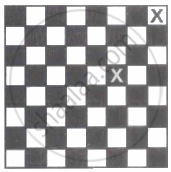
Let P denotes the probability of selecting one white and one black square from the chessboard so that they are not in the same row and also not in the same column (an example of this kind of the choice is shown in figure), then (1024)P is ______.
In an entrance test, there are multiple choice questions. There are four possible answers to each question, of which one is correct. The probability that a student knows the answer to a question is 90%. If he gets the correct answer to a question, then the probability that he was guessing is ______.
In a company, 15% of the employees are graduates and 85% of the employees are non-graduates. As per the annual report of the company, 80% of the graduate employees and 10% of the non-graduate employees are in the Administrative positions. Find the probability that an employee selected at random from those working in administrative positions will be a graduate.
Which expression gives Bayes' Theorem for \[P(B_i\mid A)\]?
Which conditions are specified for the probabilities in Bayes' Theorem?
Which formula represents the Law of Total Probability?
Bayes' Theorem works from _____ to _____.
In a typical Bayes' Theorem question, what is usually given in the question statement?
