Advertisements
Advertisements
प्रश्न
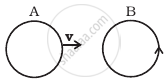
There are two coils A and B as shown in figure. A current starts flowing in B as shown, when A is moved towards B and stops when A stops moving. The current in A is counterclockwise. B is kept stationary when A moves. We can infer that ______.
विकल्प
there is a constant current in the clockwise direction in A.
there is a varying current in A.
there is no current in A.
there is a constant current in the counterclockwise direction in A.
Advertisements
उत्तर
There are two coils A and B as shown in figure. A current starts flowing in B as shown, when A is moved towards B and stops when A stops moving. The current in A is counterclockwise. B is kept stationary when A moves. We can infer that there is a constant current in the counterclockwise direction in A.
Explanation:
Due to variation in the flux linked with coil B an emf will be induced in coil B. Current in coil B becomes zero when coil A stops moving, it is possible only if the current in coil A is constant. If the current in coil A would be variable, there must be some changing flux and then there must be an induced emf. Hence an induced current will be in coil B even when coil A is not moving.
APPEARS IN
संबंधित प्रश्न
Use Lenz’s law to determine the direction of induced current in the situation described by the figure:
A wire of irregular shape turning into a circular shape.

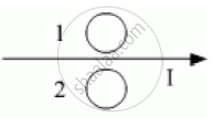
Predict the directions of induced currents in metal rings 1 and 2 lying in the same plane where current I in the wire is increasing steadily.
A short magnet is moved along the axis of a conducting loop. Show that the loop repels the magnet if the magnet is approaching the loop and attracts the magnet if it is going away from the loop.
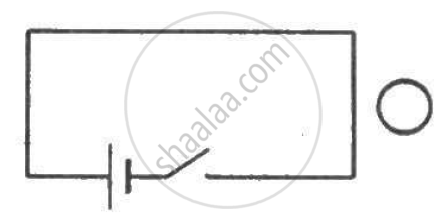
Consider the situation shown in figure. If the switch is closed and after some time it is opened again, the closed loop will show ____________ .
Two circular loops of equal radii are placed coaxially at some separation. The first is cut and a battery is inserted in between to drive a current in it. The current changes slightly because of the variation in resistance with temperature. During this period, the two loops _______________ .
Lenz’s law is a consequence of the law of conservation of ______.
Which of the following statements is not correct?
2 A 40 kg boy whose legs are 4 cm in area and 50 cm long falls through a height of 2 m without breaking his leg bones. If the bones can withstand stress of 0.9 x 10⁸ N/m2. The Young's modulus for the material of the bone is ______.
Lenz's law gives ______
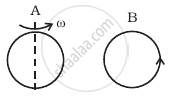
Same as problem 4 except the coil A is made to rotate about a vertical axis (figure). No current flows in B if A is at rest. The current in coil A, when the current in B (at t = 0) is counterclockwise and the coil A is as shown at this instant, t = 0, is ______.
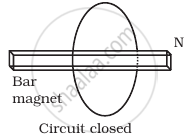
Consider a magnet surrounded by a wire with an on/off switch S (Figure). If the switch is thrown from the off position (open circuit) to the on position (closed circuit), will a current flow in the circuit? Explain.

Consider a metal ring kept on top of a fixed solenoid (say on a carboard) (Figure). The centre of the ring coincides with the axis of the solenoid. If the current is suddenly switched on, the metal ring jumps up. Explain

A metallic ring of mass m and radius `l` (ring being horizontal) is falling under gravity in a region having a magnetic field. If z is the vertical direction, the z-component of magnetic field is Bz = Bo (1 + λz). If R is the resistance of the ring and if the ring falls with a velocity v, find the energy lost in the resistance. If the ring has reached a constant velocity, use the conservation of energy to determine v in terms of m, B, λ and acceleration due to gravity g.
Predict the direction of induced current in the situation described by the following figure.

Predict the direction of induced current in the situation described by the following figure.

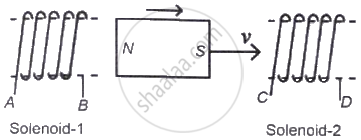
In the diagram given below, a strong bar magnet is moving towards solenoid-2 from solenoid-1. The direction of induced current in solenoid-1 and that in solenoid-2, respectively, are through the directions:
What does the magnetic pole created on the near face of the coil oppose when a magnet moves?
In what sense does Lenz's law behave like electromagnetic inertia?
