Advertisements
Advertisements
प्रश्न
The volume of air that remains in the lungs after maximum respiration is ______.
विकल्प
1000 to 1100 ml
1100 to 1200 ml
2000 to 3000 ml
5200 to 5800 ml
Advertisements
उत्तर
The volume of air that remains in the lungs after maximum respiration is 1100 to 1200 ml
संबंधित प्रश्न
Long answer question:
Smita was working in a garage with the doors closed and automobile's engine running. After some time she felt breathless and fainted. What would be the reason? How can she be treated?
After a long deep breath, we do not respire for some seconds due to ______.
Make the correct pairs.
| Column – I | Column – II |
| (P) Tidal volume | i. 1000 to 1100 ml |
| (Q) Residual volume | ii. 500 ml |
| (R) Expiratory reserve volume | iii. 2500 to 3000 ml |
| (S) Inspiratory reserve volume | iv. 1100 to 1200 ml |
Identify the CORRECT statement.
When you hold your breath, identify the gas changes that occur in blood and would first lead to the urge to breathe.
Assertion: During inhalation, the diaphragm goes downward.
Reason: The volume of the thoracic cavity decreases.
The partial pressures (in mm Hg) of oxygen (O2) and carbon dioxide (CO2) at alveoli (the site of diffusion) are ______
Mark the true statement among the following with reference to normal breathing.
What is phosphorylation?
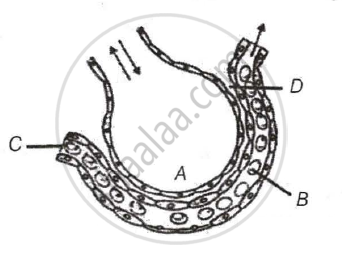
The figure given below shows a small part of human lung where exchange of gas takes place. In which one of the options given below, the one part A, B, C or D is correctly identified along with its function.