Advertisements
Advertisements
प्रश्न
Define Hamburger’s phenomenon. Add a note on it.
Advertisements
उत्तर
Hamburger’s phenomenon or chloride shift refers to diffusion of chloride ions into the RBCs of to maintain the ionic balance between the RBCs and the plasma.
The rate of formation of carbonic acid inside the RBC is very high as compared to its formation in the plasma. Carbonic acid being unstable almost immediately dissociates into HCO3 − and H+ in the presence of the enzyme carbonic anhydrase (CA) leading to accumulation of large amount of HCO3 − inside the RBCs.
CO2 + H2O →CA ← H2CO3 →CA ← H+ + HCO3 − It thus, moves out of the RBCs causing an imbalance of the charge inside the RBCs. To maintain the ionic balance between the RBCs and the plasma, Cl- diffuses into the RBCs.
संबंधित प्रश्न
Differentiate between cyclic and non-cyclic photophosphorylation.
The size of the chest cavity increases during inhalation.
Answer briefly the following:
What is the difference between breathing and respiration?
How is the process of respiration different from breathing?
The Tidal Volume of a normal person is ______.
Identify the CORRECT statement.
Observe the figures given in figure (A) and (B) and answer the following.
- Which of the figures A or B indicates the process of inhalation and which the process of exhalation?
- In the figure label the arrows and indicate the direction of
- movement of air
- movement of diaphragm
- movement of ribs
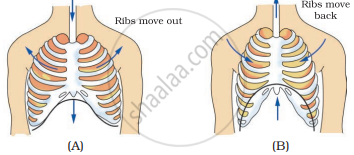
Explain the mechanism of breathing with neat labelled sketches.
Which of the following is correct regarding pneumotoxic centres?
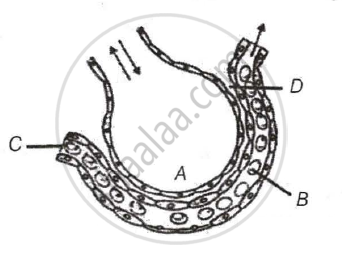
The figure given below shows a small part of human lung where exchange of gas takes place. In which one of the options given below, the one part A, B, C or D is correctly identified along with its function.