Advertisements
Advertisements
प्रश्न
Define total lung capacity.
Advertisements
उत्तर
The maximum amount of air that the lungs can hold after a maximum forceful inspiration is known as total lung capacity
APPEARS IN
संबंधित प्रश्न
What is 'photophosphorylation'?
Describe non-cyclic photophosphorylation with schematic representation. Give its significance.
Distinguish between inspiration and expiration.
During inspiration, the diaphragm ______.
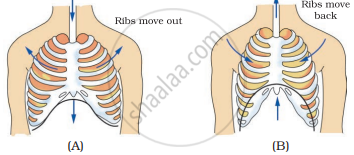
Observe the figures given in figure (A) and (B) and answer the following.
- Which of the figures A or B indicates the process of inhalation and which the process of exhalation?
- In the figure label the arrows and indicate the direction of
- movement of air
- movement of diaphragm
- movement of ribs
Lungs do not collapse between breaths and some air always remains in the lungs which can never be expelled because ______.
The partial pressures (in mm Hg) of oxygen (O2) and carbon dioxide (CO2) at alveoli (the site of diffusion) are ______
Which of the following is correct regarding pneumotoxic centres?
In HMP shunt, number of molecules of CO2 evolved are ______.
Listed below are four respiratory capacities (1 - 4) and four jumbled respiratory volumes of a normal human adult
| Respiratory Capacities | Respiratory Volumes |
| 1. Residual volume | 2500 mL |
| 2. Vital capacity | 5500 mL |
| 3. Inspiratory sore volume | 1200 mL |
| 4. Total Lung capacity | 4500 mL |
Which one of the following is the correct matching of two capacities and volumes?
