Advertisements
Advertisements
प्रश्न
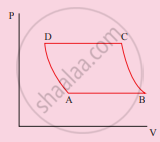
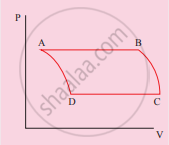
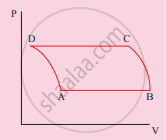
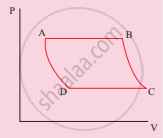
The V-T diagram of an ideal gas which goes through a reversible cycle A→B→C→D is shown below. (Processes D→A and B→C are adiabatic)

The corresponding PV diagram for the process is (all figures are schematic)
विकल्प
Advertisements
उत्तर
APPEARS IN
संबंधित प्रश्न
Draw a p-V diagram of the irreversible process.
Write a note on free expansion.
Explain work done during a thermodynamic process.
When you exercise in the morning, by considering your body as a thermodynamic system, which of the following is true?
In an isochoric process, we have ____________.
Derive the work done in an isothermal process.
Explain the isobaric process and derive the work done in this process.
In an isothermal process, the volume of an ideal gas is halved. One can say that ____________.
Ideal gas for which 'ϒ' = 1.5 is suddenly compressed to `1/4`th of its initial volume. The ratio of 4 the final pressure to the initial pressure is ______.
`(ϒ = "C"_"p"/"C"_"v")`
Explain the thermodynamic process.
