Advertisements
Advertisements
प्रश्न
The sum of the multiplication table of natural number ‘n’ is given by 55 × n. Find the sum of table of 19.
Advertisements
उत्तर
Given, the sum of multiplication table of n natural numbers = 55 × n
Sum of table of 19 = 55 × 19 ...[Put n = 19]
= 1045
APPEARS IN
संबंधित प्रश्न
Observe the patterns of digits made from line segments of equal length. You will find such segmented digits on the display of electronic watches or calculators.
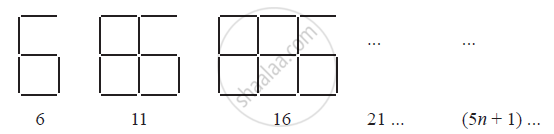
If the number of digits formed is taken to be n, the number of segments required to
form n digits is given by the algebraic expression appearing on the right of each pattern.
How many segments are required to form 5, 10, 100 digits of the kind −

Write down the following in the product form: x2y4
Write down the following in the product form: 10a3b3c3
If 9 is added to a certain number, the result is 36. Find the number.
When Raju multiplies a certain number by 17 and adds 4 to the product, he gets 225. Find that number.
Find two numbers such that one of them is five times the other and their difference is 132.
Deepak is twice as old as his brother Vikas. If the difference between their ages is 11 years, find their present ages.
The area of a square having each side x is ______.
If I spend f rupees from 100 rupees, the money left with me is ______ rupees.
If m is a whole number, then 2 m denotes a multiple of 2.
The additive inverse of an integer x is 2x.
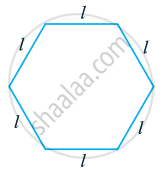
The side of a regular hexagon is denoted by l. Express the perimeter of the hexagon using l.
(Hint: A regular hexagon has all its six sides equal in length.)
To find sum of three numbers 14, 27 and 13, we can have two ways:
- We may first add 14 and 27 to get 41 and then add 13 to it to get the total sum 54 or
- We may add 27 and 13 to get 40 and then add 14 to get the sum 54. Thus, (14 + 27) + 13 = 14 + (27 + 13)
This can be done for any three numbers. This property is known as the associativity of addition of numbers. Express this property which we have already studied in the chapter on whole numbers, in a general way, by using variables a, b and c.
The sum of first n natural numbers is given by `1/2n^2 + 1/2n`. Find the sum of first 5 natural numbers.
The sum of first n natural numbers is given by `1/2n^2 + 1/2n`. Find the sum of natural numbers from 11 to 30.
The sum of the multiplication table of natural number ‘n’ is given by 55 × n. Find the sum of table of 7.
If  = 2x + 3,
  = `3/2x + 7` and
  = x – 3 then find the value of:
2 +
+  –
– 
If = 2x + 3, = `3/2x + 7` and = x – 3 then find the value of:
`1/2` +
+  – 3
– 3
