Advertisements
Advertisements
प्रश्न
Write an expression for the sum of 1 and twice a number n. If you let n be any odd number, will the result always be an odd number?
Advertisements
उत्तर
Let the number be n
So, according to the statement, the expression can be written as = 2n + 1
Yes, the result is always an odd number, because when a number becomes multiplied by 2, it becomes even and addition of 1 in that even number makes it an odd number.
APPEARS IN
संबंधित प्रश्न
Observe the patterns of digits made from line segments of equal length. You will find such segmented digits on the display of electronic watches or calculators.
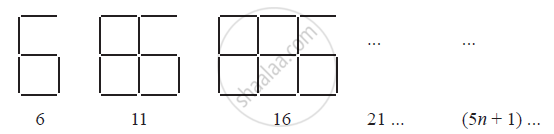
If the number of digits formed is taken to be n, the number of segments required to
form n digits is given by the algebraic expression appearing on the right of each pattern.
How many segments are required to form 5, 10, 100 digits of the kind −

Observe the patterns of digits made from line segments of equal length. You will find such segmented digits on the display of electronic watches or calculators.
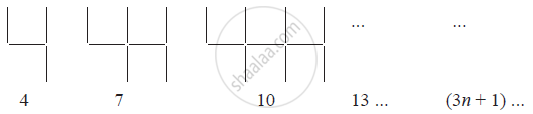
If the number of digits formed is taken to be n, the number of segments required to form n digits is given by the algebraic expression appearing on the right of each pattern.
How many segments are required to form 5, 10, 100 digits of the kind −

Write down the following in the product form: 6y5
Write down the following in the product form: 10a3b3c3
If 9 is added to a certain number, the result is 36. Find the number.
The sum of three consecutive natural numbers is 114. Find the numbers.
When Raju multiplies a certain number by 17 and adds 4 to the product, he gets 225. Find that number.
The sum of two consecutive even numbers is 74. Find the numbers.
The sum of three consecutive odd numbers is 21. Find the numbers.
A cube is a three-dimensional figure as shown in the given figure. It has six faces and all of them are identical squares. The length of an edge of the cube is given by l. Find the formula for the total length of the edges of a cube.

The diameter of a circle is a line which joins two points on the circle and also passed through the centre of the circle. (In the adjoining figure AB is a diameter of the circle; C is its centre.) Express the diameter of the circle (d) in terms of its radius (r).

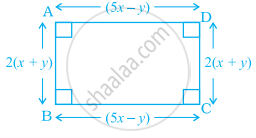
Find the perimeter of the figure given below:
A wire is (7x – 3) metres long. A length of (3x – 4) metres is cut for use. Now, answer the following questions:
- How much wire is left?
- If this left out wire is used for making an equilateral triangle. What is the length of each side of the triangle so formed?
The sum of first n natural numbers is given by `1/2n^2 + 1/2n`. Find the sum of first 5 natural numbers.
The sum of first n natural numbers is given by `1/2n^2 + 1/2n`. Find the sum of first 11 natural numbers.
The sum of squares of first n natural numbers is given by `1/6n(n + 1)(2n + 1)` or `1/6(2n^3 + 3n^2 + n)`. Find the sum of squares of the first 10 natural numbers.
If  = 2x + 3,
  = `3/2x + 7` and
  = x – 3 then find the value of:
`1/2` +
+  – 3
– 3
