Advertisements
Advertisements
प्रश्न
If  = `3/4x - 2` and
 = x + 6, then find the value of:
 –

Advertisements
उत्तर
Given, = `3/4x - 2` and = x + 6
– = `3/4 xx 10 - 2 - 4 - 6`
= `30/4 - 12/1` ...[∵ LCM of 4 and 1 is 4]
= `(30 - 48)/4`
= `(-18)/4`
= `(-9)/2`
APPEARS IN
संबंधित प्रश्न
When Raju multiplies a certain number by 17 and adds 4 to the product, he gets 225. Find that number.
Find two numbers such that one of them is five times the other and their difference is 132.
The sum of two consecutive even numbers is 74. Find the numbers.
A man is 4 times as old as his son. After 16 years he will be only twice as old as his son. Find their present ages.
A man is thrice as old as his son. Five years ago the man was four times as old as his son. Find their present ages.
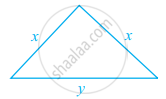
The perimeter of the triangle shown in the following figure is ______.
The area of a square having each side x is ______.
If m is a whole number, then 2 m denotes a multiple of 2.
If x is a negative integer, – x is a positive integer.
The side of a regular hexagon is denoted by l. Express the perimeter of the hexagon using l.
(Hint: A regular hexagon has all its six sides equal in length.)

To find sum of three numbers 14, 27 and 13, we can have two ways:
- We may first add 14 and 27 to get 41 and then add 13 to it to get the total sum 54 or
- We may add 27 and 13 to get 40 and then add 14 to get the sum 54. Thus, (14 + 27) + 13 = 14 + (27 + 13)
This can be done for any three numbers. This property is known as the associativity of addition of numbers. Express this property which we have already studied in the chapter on whole numbers, in a general way, by using variables a, b and c.
The side length of the top of square table is x. The expression for perimeter is ______.
The expression for the number of diagonals that we can make from one vertex of a n sided polygon is ______.
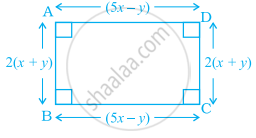
Find the perimeter of the figure given below:
The sum of first n natural numbers is given by `1/2n^2 + 1/2n`. Find the sum of first 11 natural numbers.
If  = 2x + 3,
 = `3/2x + 7` and
 = x – 3 then find the value of:
2 +
 –

Write an expression for the sum of 1 and twice a number n. If you let n be any odd number, will the result always be an odd number?
