Advertisements
Advertisements
प्रश्न
The shiny outer surface of a hollow sphere of aluminium of radius 50 cm is to be used as a mirror:
State whether this spherical mirror will diverge or converge light rays.
Advertisements
उत्तर
This spherical mirror will diverge the light rays.
APPEARS IN
संबंधित प्रश्न
An image formed by a ______ mirror is always of the same size as that of the object.
Which type of mirror can form a real image?
A virtual image larger than the object can be produced by a ______.
When a spherical mirror is held towards the sun and its sharp image is formed on a piece of a carbon paper for some time, a hole is burnt in the carbon paper.
What is the advantage of using a carbon paper rather than a white paper?
The shiny outer surface of a hollow sphere of aluminium of radius 50 cm is to be used as a mirror:
Which type of spherical mirror will it provide?
Mention the types of mirrors used as (i) rear view mirrors, (ii) shaving mirrors. List two reasons to justify your answers in each case.
The diagram below in Figure, shows a convex mirror. C is its centre of curvature and F is its focus. (i) Draw two rays from A and hence locate the position of image of object OA. Label the image IB. (ii) State three characteristics of the image.
Write two more characteristics of the image.
Name the kind of mirror used to obtain:
A virtual and enlarged image
Write the spherical mirror's formula and explain the meaning of each symbol used in it.
An object forms a virtual image which is 1/8th of the size of the object. If the object is placed at a distance of 40 cm from the convex mirror, calculate:
- the position of the image
- the focal length of the convex mirror.
Define the following term in relation to concave mirror.
Focal length
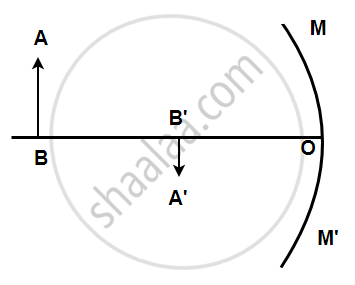
AB is the object, A'B' is the image, and MM' is the position of the mirror. Complete the ray diagram showing the formation of the image and find the focal length of the mirror.
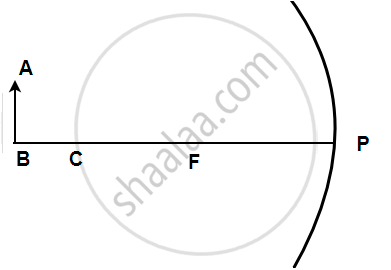
The following figure shows a concave mirror with its pole (P), focus (F), and center of curvature (C). Draw a ray diagram to show the formation of the image of an object AB by the concave mirror.
The distance from the pole to the focus is called ______.
Define focal length.
Name the type of mirror used in the following situation:
Side/rear-view mirror of a vehicle
Support your answer with reason.
In normal adjustment, for a refracting telescope, the distance between objective and eye piece is 30 cm. The focal length of the objective, when the angular magnification of the telescope is 2, will be ______.
