Advertisements
Advertisements
प्रश्न
The pressure in the water pipe on the ground floor of a building is 40000 pascals, whereas on the first floor it’s 10000 pascals. Find the height of the first floor. (Acceleration due to gravity g = 10 ms−2)
Advertisements
उत्तर
Pressure on the ground floor of a building = P1 = 40000 Pa
Pressure on the first floor of a building = P2 = 10000 Pa
ρ = 1000 kg/m3 = density of water
Acceleration due to gravity = g = 10 m/s2
Difference in pressure = P1 – P2 = 40000 – 10000 = 30000 Pa
Let h = height of first floor
Pressure of water due to height (h) = hρg
30000 = h × 1000 × 10
h = `30000/10000` = 3 m
APPEARS IN
संबंधित प्रश्न
Consider the equations `P=lim_(triangles->0)"F"/(triangle"S")` and P1 - P2 = pgz. In an elevator accelerating upward
Name two applications of Pascal's law.
In a hydraulic machine, a force of 2 N is applied on the piston of area of cross section 10 cm2. What force is obtained on its piston of area of cross section 100 cm2 ?
If the mechanical advantage of the handle of the pump plunger is 8, calculate the force applied at the end of the handle of the pump plunger.
Select the correct option.
Pressure applied in liquids is transmitted with undiminished force
How does the liquid pressure on a diver change according to the following condition:
When the driver moves to the greater depth?
State the principle on which Brahma press depends.
Assertion: Pascal’s law is the working principle of a hydraulic lift.
Reason: Pressure is thrust per unit area.
Consider a water tank shown in the figure. It has one wall at x = L and can be taken to be very wide in the z direction. When filled with a liquid of surface tension S and density ρ, the liquid surface makes angle θ(θ << 1) with the x-axis at x = L. If y(x) is the height of the surface then the equation for y(x) is:
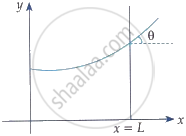
(take θ(x) = sin θ(x) = tan θ(x) = `dy/dx`, g is the acceleration due to gravity)
