Advertisements
Advertisements
प्रश्न
The organs A of a person have been damaged completely due to which too much of a poisonous waste material B has started accumulating in his blood, making it dirty. In order to save this person's life, the blood from an artery in the person's arm is made to flow into long tubes made of substance E which are kept in coiled form in a tank containing solution F. This solution contains three materials G, H and I in similar proportions to those in normal blood. As the person's blood passes through long tubes of substance E, most of the wastes present in it go into solution. The clean blood is then put back into a vein in the arm of the person for circulation.
(a) What are organs A?
(b) Name the waste substance B.
(c) What are (i) E, and (ii) F?
(d) Name G, H and I.
(e) What is the process described above known as?
Advertisements
उत्तर
(a) Organ A is kidney. Complete damage of the kidney (organ A) can lead to the accumulation of waste material B, i.e. urea, in the blood.
(b) The waste substance B is urea.
(c)
(i) In dialysis, the blood from a convenient artery is pumped into the dialyser of a dialysing machine. The dialyser contains a coiled cellophane tube made of substance E, called cellulose. It is surrounded by the dialysing solution (F). Hence, E represents cellulose.
(ii) F represents the dialysing solution.
(d) The dialysing solution contains water (G), glucose (H) and salts (I), which is similar in concentration to those in normal blood.
(e) The process of removing waste substances like urea from the blood using a kidney machine is known as dialysis.
APPEARS IN
संबंधित प्रश्न
Why is it necessary to excrete waste products?
_____________ secreted by the (ii) _____________ lobe of the pituitary gland. If this hormone secretion is reduced, there is an increased production of urine. This disorder is called (iii) ____________. Sometimes excess glucose is passed with urine due to hyposecretion of another hormone called (iv) _____________ leading to the cause of a disease called (v) ______________.
The form in which glucose in stored in liver.
State whether the following statement is true or false:
Some organisms store wastes in body parts.
Fill in the following blank with suitable word:
Bowman's capsule and tubule taken together make a..........
How are waste products excreted in Amoeba?
Where is urine carried through ureters?
The procedure of cleaning the blood of a person by using a kidney machine is known as:
(a) ketolysis
(b) hydrolysis
(c) dialysis
(d) photolysis
Differentiate between
excretion and transpiration
Given below is a diagram of a human kidney, cut open longitudinally. Answer the following:

(i) Give definition of excretion.
(ii) Name the unit of kidney.
(iii) Why does the cortex of kidney show dotted appearance?
(iv) List the functions of the kidney.
Study the diagram given alongside and then answer the question that follow:
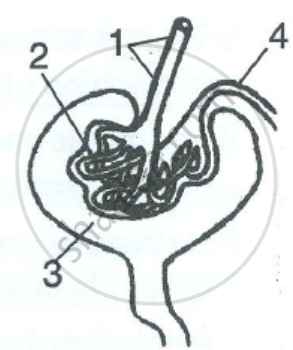
Name the parts labelled 1, 2, 3, and 4.
Study the diagram given alongside and then answer the question that follow:
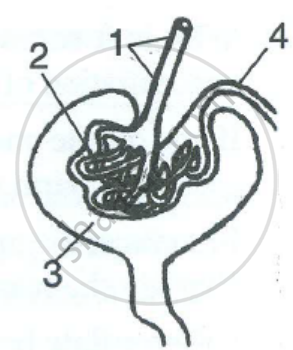
Name the stages involved in the formation of urine.
Describe in brief how urine is produced in the human body.
Give Technical Term:
The tube joining the kidney to the urinary bladder.
Complete the following sentence with appropriate word:
Human kidney is made up of ______.
State the Location: Renal pyramids
Write the functional activity of the following structure: Vasopressin
Write the functional activity of the following structure:
Glomerulus
Among the following animals, the best conserver of water is ______.
Give two examples of the following:
Main excretory organs
