Advertisements
Advertisements
प्रश्न
The number of shells decreases in a group from top to bottom.
विकल्प
Right
Wrong
Advertisements
उत्तर
The number of shells decreases in a group from top to bottom- Wrong
APPEARS IN
संबंधित प्रश्न
Write down the electronic configuration of the following elements from the given atomic numbers. Answer the following question with explanation.
7N, 6C, 8O, 5B, 13Al Which is the most electronegative element among these?
Write down the electronic configuration of the following elements from the given atomic numbers. Answer the following question with an explanation.
13Al, 14Si, 11Na, 12Mg, 16S
Which of the above elements has the highest metallic character?
Write down the electronic configuration of the following elements from the given atomic numbers. Answer the following question with explanation.
6C, 3Li, 9F, 7N, 8O Which of the above elements has the highest nonmetallic character?
An element has its electron configuration as 2,8,2. Now answer the following questions.
i. What is the atomic number of this element?
ii. What is the valency of this element?
iii. What is the group of this element?
iv. To which period does this element belong?
v. With which of the following elements would this element resemble?
`_7N , _4Be , _18Ar , _17CL`
An element has its electron configuration as 2, 8, 2. Now answer the following question.
With which of the following elements would this element resemble?
(Atomic numbers are given in the brackets)
N(7), Be(4), Ar(18), Cl(17)
Which pair of atomic numbers represents elements in the same group?
Find the odd one out and give its explanation.
Find the odd one out and give its explanation.
What determines the chemical reactivity of elements?
Write the name.
The group of elements having electronic configuration 2, 2.
The elements lithium and beryllium are in the same period because their valencies are similar.
Beryllium and calcium are alkaline earth metals.
Write scientific reason.
Boron and oxygen elements are placed in the second period in periodic table.
Complete the following chart.
| Shell | n | 2n2 | Electron holding capacity |
| K | ______ | 2 × 12 | 2 |
| L | 2 | ______ | 8 |
| ______ | 3 | 2 × 32 | 18 |
| N | 4 | 2 × 42 | ______ |
Distinguish between:
Group - Period
Observe the periodic table given below and write the answers of the questions.
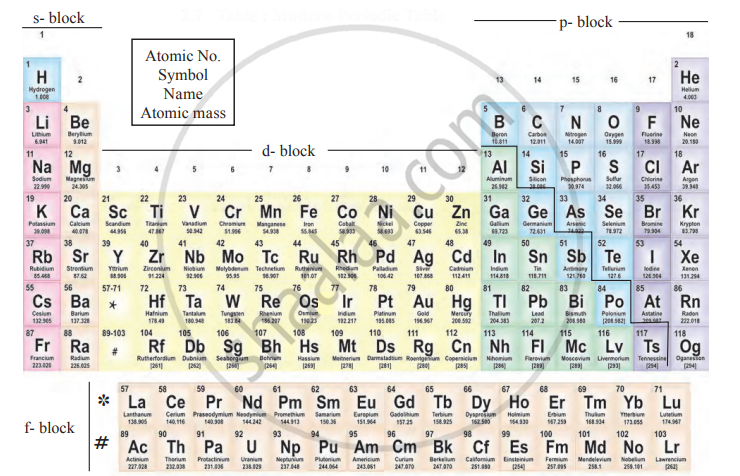
- Write the name and valencies of the elements in 3rd row.
- Classify the elements in this row as metal, nonmetal and metalloids.
- Which block does nonmetals belong to?
- Write name of any two metalloid elements.
Make a chart which shows the name of the element, valency, atomic number, electronic configuration in the 2nd row of the modern periodic table and arrange these elements in ascending order of atomic mass.
An element has its electron configuration as 2, 8, 1. Now answer the following questions:
- What is the atomic number of this element?
- What is the group of this element?
- To which period does this element belong?
