Advertisements
Advertisements
प्रश्न
Advertisements
उत्तर
APPEARS IN
संबंधित प्रश्न
An element `""_ZS^A` decays to `""_85R^222` after emitting 2 α particles and 1 β particle.
Find the atomic number and atomic mass of the element S.
Radiations given out from a source when subjected to an electric field in a direction perpendicular to their path are shown below in the diagram. The arrows show the path of the radiation A, B and C. Answer the following questions in terms of A, B and C.
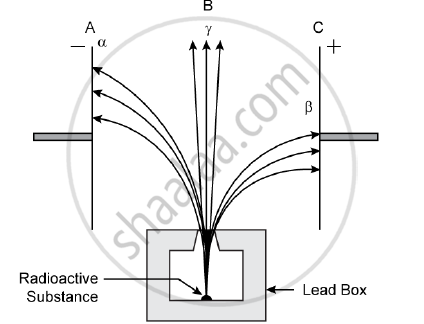
1) Name the radiation B which is unaffected by the electrostatic field.
2) Why does the radiation C deflect more than A?
3) Which among the three causes the least biological damage externally.
4) Name the radiation which is used in carbon dating.
State three safety precautions that you would take while handling the radioactive substances.
Justify with reason, whether the following nuclear reactions are allowed or not.
\[\ce{^A_Z X -> ^A_{Z - 2}X + ^4_{2}He}\]
From α, β and γ-rays, name the one which is not affected by electric or magnetic field?
It is advised not to touch a radioactive substance by hand. Give reason.
Heavy radioactive elements eventually turn into ______.
Calculate the time interval between 33% decay and 67% decay if half-life of a substance is 20 minutes.
Assertion (A): The force of repulsion between atomic nucleus and α-particle varies with distance according to inverse square law.
Reason (R): Rutherford did α-particles scattering experiment.
Which decay process involves the emission of a particle with a comparatively large mass and a positive charge?
