Advertisements
Advertisements
प्रश्न
A nucleus $${}_{84}\mathrm{X}^{202}$$ of an element emits an alpha particle followed by a beta particle. The final nucleus is $${}_{\mathrm{a}}\mathrm{Y}^{\mathrm{b}}$$. Find a and b.
Advertisements
उत्तर
Given: Initial nucleus = \({}_{84}^{202}X\)
Final nucleus = \({}_{a}^{b}Y\)
Number of \(\alpha\)-particles emitted = 1
Number of \(\beta\)-particles emitted = 1
The atomic number (a).
Each \(\alpha\)-particle emission decreases the atomic number by 2, while each \(\beta^{-}\)-particle emission increases it by 1.
\[ a=84-2+1 \]
\[ a=82+1 \]
\[ \therefore a=83 \]
The mass number (b).
Each \(\alpha\)-particle emission decreases the mass number by 4, while \(\beta\)-particle emission does not change it.
\[ b=202-4+0 \]
\[ \therefore b=198 \]
संबंधित प्रश्न
What do you mean by Mass number.
State the penetrating range of α, β and γ radiations.
Give the relative ionizing power of α, β and γ radiations.
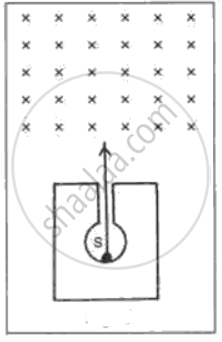
In following fig. shows a mixed source S of alpha and beta particles in a thick lead container. The particles pass through a magnetic field in a direction perpendicular to the plane of paper (inwards as shown by x). State and show in the diagram how the particles get affected.
Define the term radioactivity.
A radioactive source emits three types of radiations.
Name the radiation which has the highest ionizing power.
Define free electrons.
In the following atoms, which one is a radioisotope? Give one use of this isotope.
O16, C14, N14, He4
Assertion (A): Hydrogen atom consists of only one electron but its emission spectrum has may lines.
Reason (R): Only Lyman series is found in the absorption spectrum of hydrogen atom whereas in the emission spectrum, all the series are found.
Which decay process involves the emission of a particle with a comparatively large mass and a positive charge?
