Advertisements
Advertisements
प्रश्न
The last part of the extract that you have just heard is given below. Notice


how the author creates interest through a step-by-step organisation of his ideas.
| Within the diamond haze of the beach, something dark was fumbling along. Ralph saw it first and watched until the intentness of his gaze drew all eyes that way. Then the creature stepped from the mirage on to clear sand and they saw that the darkness was not all shadow but mostly clothing. The creature was a party of boys marching approximately in step falling on two parallel lines. |
The author uses these words to create an atmosphere of mystery and suspense. The 'something' becomes clearer ... clearer still .... until finally we learn what it really is. |
Advertisements
उत्तर
For self-attempt
APPEARS IN
संबंधित प्रश्न
You are the grandmother. How did you feel when your granddaughter gave you the novel ‘Kashi Yatre’ ? Write your feelings in your diary.
To make your diary entry interesting, read the following information about what is a diary entry.
A diary entry is a purely personal piece of writing. The writer expresses his/her thoughts and feelings. Reactions to incidents are generally poured out in a diary. Hence expressions that are emotionally charged are used.
For example – When you are happy about something, you could start like this
8th July 20xx, Wednesday 8 pm
Today I am very happy as ………………………..
You are the ‘ProfessorWrite a diary entry after your first day at the cookhouse, describing the events that led to this assignment, also express your thoughts and feelings about the events of the day in about 175 words.
The sequence of events has been jumbled up. Rearrange them and complete the given flowchart.
(1) Major Percy and Bill come to the house.
(2) Harold comes to know that his father is a boxer.
(3) Bill tells his wife that he is doing it for Harold.
(4) Jerry Fisher tries to convince Bill to reconsider.
(5) Mrs. Bramble is amazed to think that she has brought such a prodigy as Harold into the world.
(6) Harold wants to know what will happen to the money he had bet on Murphy losing.(7) Mrs. Bramble is informed that Bill had decided not to fight.
(8) Mrs. Bramble resumes work of darning the sock.
(9) Harold is alone with his mother in their home.

Based on your reading of the story, answer the following question by choosing
the correct option.
“Bully”, said Pescud brightening at once.
He means to say that____
Working in groups of four, write the article on the following :
The elderly seek attention and company from younger members of their family. They are eager to listen and long to share their life experiences. John A Pescud is not only respectful but also very patient with Colonel Allyn, Jessie’s father. As a reporter, write an article for a newspaper, on the importance of the elderly in our lives.
The poem is full of images that come alive through skilful use of words. Describe
any two images that appeal to you the most, quoting the lines from the poem.
Complete the web chart showing choices and decisions you may have to make in the next few years and the factors that affect these choices:

Share your choices and decisions with your partner.
Have you made choices that are acceptable and less ‘risky’ or have you followed the beaten track? Why?
Read the following extracts and answer the question that follow by choosing the correct options.
'But your parents would take possession of it, every year from the beginning of spring
until the end of September. What's more they would bring the whole tribe of your sister's
children with them.'
(a) What does Gaston mean by 'take possession'?
(i) her parents would stay with them for a long time.
(ii) Juliette's sister has many children.
(iii) Gaston does not like children.
(iv) Juliette's sister's children are badly behaved.
Answer the following question briefly.
Do you think the Bishop was right in selling the salt-cellars? Why/ Why not?
You have read an account of the final stages or Amelia's life. It had been a saga of struggle and courage. Read about her early life - the factors that inspired her to become an aviator and the difficulties she raced. Make a project on her life. Here is a list or the reference books and websites which will guide you in your endeavour. It can also be in the form or a CD.
REFERENCE ON AMELIA EARHART
o The Sound of Wings by Mary S. Lovell, 1989, Century-Hutchinson Ltd., ISBN 0-09-1 73596-3
o Last Flight by Amelia Earhart (arranged by George Palmer Putnam from correspondence), 1988, Crown Publishers, ISBN 0-51 7-56794-6
o The Epic of Flight: Women Aloft by Valerie Moolman, Time/ Life Books, ISBN 0-8094-3289-7
o Biography: Amelia Earhart by Blythe Randolph, 1987, Frankin Watts Publisher, ISBN 0-531-100331-5
WEBSITES
1) `"www.ellensplace.net/eaeintr.html"`
2) en.wikipedia.org/wiki/Amelia_Earhart
3) `"www.acepilots.com/earhart.html"`
Present Perfect Continuous
“What have you been doing?”
Imagine what people have been doing or what are the things that have been happening.
| Ashok comes in wearing white shorts, a T-shirt and carrying a racquet. He is sweating. | ||
| I think | he has been playing | tennis |
| I imagine | badminton | |
| Perhaps | badminton | |
“Living conditions have been improving….”
Key
——- Number of children in secondary school.
——- Number of people dying from malnutrition.
——- Number of homes with running water.
——- Number of women working outside the home.
Write a report on the changes in living conditions in Medland between 1950 and now. Suggest reasons for these changes. Use the present perfect continuous where necessary. You may wish to use the words in the vertical box above right.
(b) The number of homes with running water has been rising sharply since 1985, whereas
Answer the following question by ticking the correct option.
John Douglas had won quite a reputation for himself in Birlstone because of his __________________
In Question 3, you read an eye-witness account of a robbery. On the basis of your reading of the Birlstone tragedy, in about 125 words, write Dr Wood's account of the discovery of John Douglas's body.
Use the information in the headlines to complete the sentences. Choose the correct option from those given.
(a) Women Rescue Child
Two brave women of Rampur village ____________ kidnapped by his father’s distant relative.
- have rescued a child who has been
- have rescued a child who was being
- rescued a child who had been
- rescued a child who was
(b) Two killed in Collision
Two passengers travelling in a car died ____________. The driver of the truck is absconding.
- after their collision of a truck
- in a collision with a truck
- after their car collided in a truck
- when their car collided with a truck
(c) Ban on Smoking
Smoking ____________ in all public places.
- has been banned
- is being banned
- banned
- was banned
(d) Old Building Demolished
Keeping in mind the dilapidated condition of ____________ yesterday.
- the building, it was demolish
- the building, it was demolished
- the building, it has been demolished
- the building, it will be
The Passive in Tentative Statements
The passive is often used in tentative statements where the writer tries to be as neutral as possible.
| considered | to | be… | ||
| It | is | said | ||
| known | to | have been… | ||
| They | are | acknowledged believed regarded as… |
8.1
Look at the box below. Write tentative statements following the pattern in the table above.
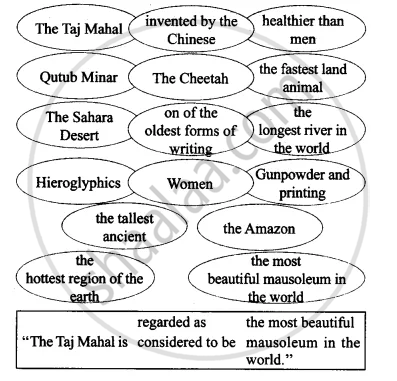
Read the following sentences. Each sentence has four words underlined. Select one underlined word that is incorrect and write it in the space provided. The first one has been done as an example:
1. The statue of liberty is designed by Fedreric Auguste Barthold.
| is |
2. Is was completely in france in july 1884.
3. The statue was shipped to New York with 350 pieces.
4. She arrieved there on 17 june 1885.
5. The pieces were put together but the opening ceremony took place on 28 Oct 1886.
Group the prepositions in the box below to indicate their use as prepositions of place (P), movement (M) or time (T). There may be more than one category for each.
| between ________ along ________ since ________ up ________ among ________ in front of ________ after ________ |
past ________ on ________ behind ________ round ________ for ________ across ________ through ________ |
before ________ until ________ beside ________ out of ________ at ________ under ________ during ________ |
Use the adjectives and prepositions from the box above to fill in the gaps below. Add eight sentences of your own.
- Mary is bad ________ Maths.
- Fruit is good ________ you.
- Ram was married ________ Beena for 10 years. They were very happy.
- This tool is more ________ planing wood.
- What good news! I’m so ________ you.
- He’s ________ her; she looks ill.
- She’s ashamed ________ her bad behaviour.
- They are fond ________ dancing.
- He was absent ________ the Science Club yesterday.
- He is sensitive ________ criticism.
