Advertisements
Advertisements
प्रश्न
The following pictograph shows the number of watches manufactured by a factory, in a particular weeks.
| Day | Number of watches |
| Monday |       |
| Tuesday |            |
| Wednesday |       |
| Thursday |       |
| Friday |      |
| Saturday |         |
Scale:  = 100 watches
Find the total number of watches manufactured in the whole week?
Advertisements
उत्तर
Total no. of watches manufactured in the whole week
= 100 x 42.5 = 4250 watches
APPEARS IN
संबंधित प्रश्न
The sale of vehicles, in a particular city, during the first six months of the year 2016 is shown below:
| Month | Jan | Feb | March | April | May | June |
| Number of vehicles sold | 3000 | 2500 | 4000 | 1000 | 1500 | 3500 |
Draw a pictograph to represent the above data.
The following pictograph shows different subject books which are kept in a school library.
| Subject | Number of books |
| Hindi |       |
| English |       |
| Math |      |
| Science |      |
| History |     |
Taking symbol of one book = 50 books, find:
How many History books are there in the library?
Representation of data by using pictures is known as ______________
The representation of ‘one picture to many objects’ in a Pictograph is called ____________
Mr. Dinesh collected the information about the rainfall of a particular city in a week from the newspaper and recorded his information in the pictograph.
| Millimeters of Rain | |
| Sunday |  |
| Monday | 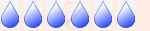 |
| Tuesday |  |
| Wednesday |  |
| Thursday |  |
| Friday |  |
| Saturday | 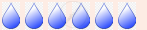 |
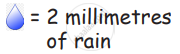
a. On which day, the rain was most?
b. On which day, the rain was least?
c. How much rain was there on Sunday?
d. How much rain was there on Monday?
e. Find total rainfall of the city in that week?
A ______ represents data through pictures of objects.
On the scale of 1 unit length = 10 crore, the bar of length 6 units will represent ______ crore and of ______ units will represent 75 crore.
Following pictograph represents some surnames of people listed in the telephone directory of a city.
| Surname | Number of people  = 100 people = 100 people |
| Khan |  |
| Patel |  |
| Rao |  |
| Roy |  |
| Saikia |  |
| Singh |  |
Observe the pictograph and answer the following questions:
- How many people have surname ‘Roy’?
- Which surname appears the maximum number of times in the telephone directory?
- Which surname appears the least number of times in the directory?
- Which two surnames appear an equal number of times?
Students of Class VI in a school were given a task to count the number of articles made of different materials in the school.
The information collected by them is represented as follows:
| Material used | Articles  = 20 articles = 20 articles |
| Wood |  |
| Glass |  |
| Metal |  |
| Rubber |  |
| Plastic |  |
Observe the pictograph and answer the following questions:
- Which material is used in maximum number of articles?
- Which material is used in minimum number of articles?
- Which material is used in exactly half the number of articles as those made up of metal?
- What is the total number of articles counted by the students?
The following pictograph depicts the information about the areas in sq km (to nearest hundred) of some districts of Chhattisgarh State:
| District | Area (in km2)  = 1000 sq km = 1000 sq km |
| Raigarh |  |
| Rajnandgaon |  |
| Koria |  |
| Mahasamund |  |
| Kabirdham |  |
| Jashpur |  |
- What is the area of Koria district?
- Which two districts have the same area?
- How many districts have area more than 5000 square kilometres?
