Advertisements
Advertisements
प्रश्न
The diagram shows a coil connected to a center zero galvanometerG . The galvanometer shows a deflect ion to the right when the north pole N of a powerful magnet is moved to the right as shown .
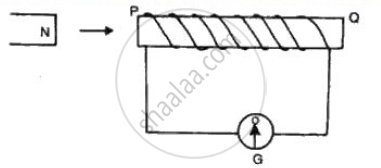
(i) Explain, why the defelct ion occurs in the galvanometer.
(ii ) State whether th e current in the coil is cl ockwise or anticl ockwise
when viewed from the end P.
(iii ) State th e observation in G when the coil is moved away from north
pole N of the magnet keeping the magnet stationary.
(iv)State the observation in G when both the coil and the magnet are
moved to right at th e same speed .
Advertisements
उत्तर
(i) This is due to change in magnetic flux in the coil. Due to change in magnetic flux an induced emf is produced in the coil. Hence, a current flows through the galvanometer.
(ii) The current appears anticlockwise when viewed from end A because end A will form north-pole.
(iii) The galvanometer now deflects towards left.
(iv) No deflection is observed as there is no relative motion between the magnet and the coil.
संबंधित प्रश्न
An electric motor takes 5 A from a 220 V line. Determine the power of the motor and the energy consumed in 2 h.
Define watt. Write down an equation linking watts, volts and amperes.
Define watt-hour. How many joules are equal to 1 watt-hour?
What is the resistance, under normal working conditions of a 240 V electric lamp rated at 60 W? If two such lamps are connected in series across a 240 V mains supply, explain why each one appears less bright.
An electric current is passed through a metallic wire. The wire gets heated up. Give the reason. Is it possible to melt the wire by passing a heavy current?
What do you understand by ‘earthing’? What are the advantages of earthing in a household electric circuit? Explain, how it is done?
You are required to connect a bulb, a fan and a socket outlet to the mains in one set A and an air-conditioner and a refrigerator to the mains in other set B. Will you recommend the wire of same thickness and same insulation in both? explain your answer.
Three 250 W heaters are connected in parallel to a 100 V supply, Calculate the resistance of each heater.
Find the heat produced in joules when a current of 10 amperes flows through a connecting wire of resistance 2 × 10⁻² ohms and heating element of resistance 250 ohms for 2 seconds.
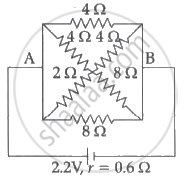
In the given figure, the emf of the cell is 2.2 V, and if internal resistance is 0.6 Ω. Calculate the power dissipated in the whole circuit.