Advertisements
Advertisements
प्रश्न
What do you understand by ‘earthing’? What are the advantages of earthing in a household electric circuit? Explain, how it is done?
Advertisements
उत्तर
By earthing we mean that the metallic body of an electric appliance is connected to thick copper wire, which is buried deep in the earth and at its end is a copper plate surrounded by a mixture of charcoal and common salt.
Advantages: It is a kind of safety device which saves us from an electric shock, in a case when the
the metal casing of the appliance happens to touch the live wire or due to short-circuiting or leakage of electric current.
Whenever an appliance which is earthed, get short-circuited, the current from the metal casing of the appliance flows into the earth which acts as an ‘electric sink’, i.e., its potential always remains zero. Due to the flow of heavy current, the fuse in that circuit melts and disconnects the appliance from the circuit.
So the user who happens to touch the appliance is protected from receiving any electric shock. Another advantage is that overheating the house wiring system is saved from being damaged and the same time from being burnt out.
Procedure: A three core, cord having three wires coated with insulation of red, brown, and green colour, is used for connecting die appliance to the mains for drawing current from the mains. At one end of the cord, red is connected to the pin marked L (live), the brown to the pin marked N (neutral) and green to a thick pin of the plug. The three wires at the other end of the cord are connected to the appliance such that live and neutral wires are connected to the element and the earth wire is connected to the metal body of the appliance so as to earth it.
Once the plug is put in the socket, the current through the appliance becomes as soon as the switch is pressed. The live wire gets connected to the live wire of the mains. Neutral wire is connected to the neutral of the mains and the earth wire gets connected to the earth in the mains.
संबंधित प्रश्न
Write an expression for the electrical power spent in flow of current through a conductor in terms of
(a) Resistance and potential difference, (b) current and resistance.
What is wrong with the circuit diagram (Fig. 34)? Carefully check the symbols and assign proper positive and negative signs to them.
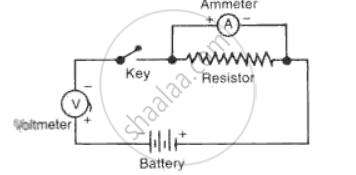
Fig . shows the essent ial features of a battery operated bell. The hammer strikes the gong when the swi tch is closed . State and explain the effect of using the following material successively to form the core.
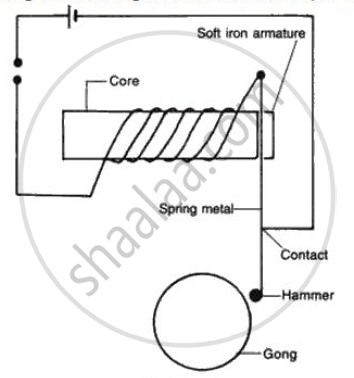
(a) Plastic
(b) Steel
(c) Copper
An electric current is passed through a metallic wire. The wire gets heated up. Give the reason. Is it possible to melt the wire by passing a heavy current?
What changes in energy occur in an electric bulb?
What changes in energy occur in an electric heater?
Two electric lamps each rating 100 W, 110 V are connected in series to a 220 V power supply and two other electric lamps each of marking 100 W, 220 V are connected in parallel to the same power supply. Will anyone of the two combinations give more light than the other? Give a reason for your answer.
State relative advantages and disadvantages of ring system of wiring over the tree system.
Find the heat produced in joules when a current of 10 amperes flows through a connecting wire of resistance 2 × 10⁻² ohms and heating element of resistance 250 ohms for 2 seconds.
Find the cost of operating an electric toaster for two hours if it draws 8 A current on a 110 volt circuit. The cost of electrical energy is Rs. 2.50 per kWh.
