Advertisements
Advertisements
प्रश्न
1 kWh = ______ J.
Advertisements
उत्तर
1 kWh = 3.6 × 10⁶ J.
APPEARS IN
संबंधित प्रश्न
Which particles are responsible for current in conductors?
Which quantity has the unit of watt?
An electric lamp is labelled 12 V, 36 W. This indicates that it should be used with a 12 V supply. What other information does the label provide?
The table below shows the current in three different electrical appliances when connected to the 240 V mains supply:
| Appliance | Current |
| Kettle | 8.5 A |
| Lamp | 0.4 A |
| toaster | 4.8 A |
- Which appliance has the greatest electrical resistance? How does the data show this?
- The lamp is connected to the main supply by using a thin, twin-cored cable consisting of live and natural wires. State two reasons why this cable should not be used for connecting the kettle to the mains supply.
- Calculate the power rating of the kettle when it is operated from the 240 V mains supply.
- A main takes the kettle abroad where the mains supply is 120 V. What is the current is the kettle when it is operated from the 120 V supply?
Electrical power P is given by the expression P = (Q × V) ÷ time. What do the symbols Q and V represent?
Fig . shows the essent ial features of a battery operated bell. The hammer strikes the gong when the swi tch is closed . State and explain the effect of using the following material successively to form the core.
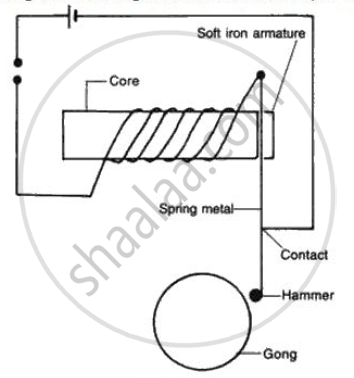
(a) Plastic
(b) Steel
(c) Copper
What are the two main systems of wiring commonly used in houses? Which of these systems mentioned by you is better and why?
An Electric bulb is marked 100 W, 230 V. What find the energy consumed by the bulb in one hour.
An Electric bulb is marked 100 W, 230 V. What current does it take?
A bulb is marked 100W, 220V and an electric heater is marked 2000 W, 220 V.
(i) What is the ratio between the resistances of these two devices?
(ii) How does the power-voltage rating of a device help us to decide about the type of leads (connecting wires) to be used for it?
(iii) In which of the above two devices, a thicker connecting wire of lead is required?
