हिंदी

The Diagram Below Shows a Circuit Containing a Lamp L, a Voltmeter and an Ammeter,. the Voltmeter Reading 3 V and the Ammeter Reading is 0.5 A.

Advertisements
Advertisements

प्रश्न

The diagram below shows a circuit containing a lamp L, a voltmeter and an ammeter,. The voltmeter reading 3 V and the ammeter reading is 0.5 A. 
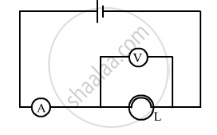
  

 What is the resistance of the lamp?
 What is the power of the lamp?

Advertisements

उत्तर

 Given:
        Potential difference = reading of the voltmeter, V = 3 V
        Current in the circuit = reading of the ammeter, I= 0.5 A
        (i)  Resistance of the lamp, `R=V/I=(3V)/0.54=6 ohm`
        (ii) Power, P = VI = 3 V x 0.5 A = 1.5 W 

shaalaa.com
  क्या इस प्रश्न या उत्तर में कोई त्रुटि है?
अध्याय 4: Electricity - Exercise 7

APPEARS IN

लखमीर सिंग Physics [English] Class 10
अध्याय 4 Electricity
Exercise 7 | Q 29.2

वीडियो ट्यूटोरियलVIEW ALL [1]

संबंधित प्रश्न

An electric fan runs from the 230 V mains. The current flowing through it is 0.4 A. At what rate is electrical energy transferred by the fan?


Which of the following is likely to be the correct wattage for an electric iron used in our homes? 

(a) 60 W
(b) 250 W
(c) 850 W
(d) 2000 W


At a given time, a house is supplied with 100 A at 220 V. How many 75 W, 220 V light bulb could be switched on in the house at the same time (if they are all connected in parallel)?


An electric heater of resistance 8 Ω takes a current of 15 A from the mains supply line. Calculate the rate at which heat is developed in the heater. 


A servo voltage stabiliser restricts the voltage output to 220 V ± 1%. If an electric bulb rated at 220 V, 100 W is connected to it, what will be the minimum and maximum power consumed by it?


An immersion heater rated 1000 W, 220 V is used to heat 0.01 m3 of water. Assuming that the power is supplied at 220 V and 60% of the power supplied is used to heat the water, how long will it take to increase the temperature of the water from 15°C to 40°C?


The coil of an electric bulb takes 40 watts to start glowing. If more than 40 W are supplied, 60% of the extra power is converted into light and the remaining into heat. The bulb consumes 100 W at 220 V. Find the percentage drop in the light intensity at a point if the supply voltage changes from 220 V to 200 V.


Write the SI units for:
(a) Electric current

(b) Potential difference

(c) Charge.


Define Kilo watt hour.


Express watt hour and kilowatt hour in joule.


An electric bulb is marked 100 W, 230 V. What does this mean?


How is the amount of heat produced calculated due to the passage of current in a metallic conductor? Derive an expression for it.


Three 250 W heaters are connected in parallel to a 100 V supply, Calculate total current taken from the supply.


An electric bulb is rated 240V-60W and is working at 100% efficiency.
(i) Calculate the resistance of bulb.
(ii) (a) Draw the circuit diagram.
(b) What is the rate of conversion of energy in each bulb?
(c) Total power used by the bulbs.


Two bulbs are rated: bulb A 100W, 120 V bulb B 10 W, 120 V. If both are connected across a 120V supply, which bulb will consume more energy, When in parallel? Also calculate the current through each bulb in the above cases.


The resistance of filament of an electric heater is 500 Ω It is operated at 200V for 1 hour daily. Calculate the current drawn by the heater and the energy consumed in kWh, by the heater in a month of 30 days.


The average work done by a human heart while it beats once is 0.5 Joule. The power used by heart if it beats 72 times in a minute:


The electrical power and current in the circuit relates by ______


1 kWh = ______ J.


Two heaters A and B have power rating of 1 kW and 2 kW, respectively. Those two are first connected in series and then in parallel to a fixed power source. The ratio of power outputs for these two cases is ______


Share
Notifications

Englishहिंदीमराठी


      Forgot password?
Use app×