Advertisements
Advertisements
प्रश्न
The diagram below represents the human heart in one phase of its function. Study the diagram carefully and answer the questions that follow:
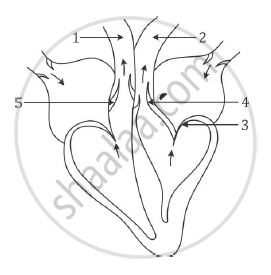
(i) Name the phase.
(ii) Which part of the heart is contracting in this phase? Give a reason to support your answer.
(iii) Name the parts labelled 1 to 4.
(iv) What type of blood flows through ‘2’?
(v) State the function of the part numbered ‘5’.
(vi) Name the membrane that covers the heart.
Advertisements
उत्तर
(i) Ventricular systole
(ii) Ventricles are contracting in this phase. In the diagram given, tricuspid valves and bicuspid valves are closed, while the semi-lunar valves are open.
(iii)
1 – Pulmonary artery
2 – Aorta
3 – Bicuspid valve
4 – Semilunar valve (aortic semilunar valve)
(iv) Oxygenated blood flows through ‘2’, i.e. aorta.
(v) ‘5’ is pulmonary semilunar valve. It prevents the backflow of blood into the right ventricle at the time of ventricular diastole.
(vi) Pericardium covers the heart.
APPEARS IN
संबंधित प्रश्न
The chief function of lymph nodes is to
The valve which prevents back flow of blood in the veins and lymph vessels ______.
Give reason for the following:
Only the veins and not the arteries are provided with valves.
Find the odd one out.
Put a tick mark (✓) against the correct alternative in the following statement.
Pulmonary vein carries
Put a tick mark (✓) against the correct alternative in the following statement.
The blood tastes saltish due to the dissolved.
Describe, in brief, the circulatory system in human beings.
Which of the following is TRUE regarding closed circulatory system?
______ refers to a marked decrease in the number of platelets.
The valve which prevents back flow of blood in the veins and lymph vessels is ______.
