Advertisements
Advertisements
प्रश्न
The diagram below represents the human heart in one phase of its function. Study the diagram carefully and answer the questions that follow:
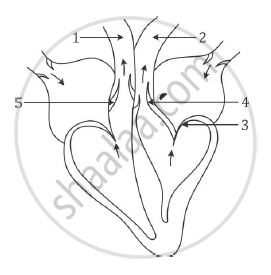
(i) Name the phase.
(ii) Which part of the heart is contracting in this phase? Give a reason to support your answer.
(iii) Name the parts labelled 1 to 4.
(iv) What type of blood flows through ‘2’?
(v) State the function of the part numbered ‘5’.
(vi) Name the membrane that covers the heart.
Advertisements
उत्तर
(i) Ventricular systole
(ii) Ventricles are contracting in this phase. In the diagram given, tricuspid valves and bicuspid valves are closed, while the semi-lunar valves are open.
(iii)
1 – Pulmonary artery
2 – Aorta
3 – Bicuspid valve
4 – Semilunar valve (aortic semilunar valve)
(iv) Oxygenated blood flows through ‘2’, i.e. aorta.
(v) ‘5’ is pulmonary semilunar valve. It prevents the backflow of blood into the right ventricle at the time of ventricular diastole.
(vi) Pericardium covers the heart.
APPEARS IN
संबंधित प्रश्न
When are the sounds "LUBB" and "DUP" produced respectively during heart beat?
What is Endothelium?
How do you account for the following difference?
The walls of the right ventricle are thicker than those of the right auricle.
What is meant by the term 'double circulation' of blood in mammals? What is diastole?
Given below is a highly schematic diagram of the human blood circulatory system.
Which numbers represent the following respectively?
Aorta
Hepatic portal vein
Pulmonary artery
Superior vena cava
Renal vein
Stomach

In which organ of our body does blood get oxygenated?
The table below is designed to indicate the transport of certain substances in our body. Fill in the blanks with suitable answers.
| Substance | From | To | |
| 1. | ______ | Lungs | Whole Body |
| 2. | Carbon Dioxide | ______ | ______ |
| 3. | Urea | ______ | ______ |
| 4. | Digested Carbohydrates | Intestines | ______ |
| 5. | ______ | ______ | Target Organs |
| 6. | Heat | ______ | Whole Body |
State the Location: Bicuspid value
Granulocytes are also known as ____________.
The heart is covered by ______.
