हिंदी

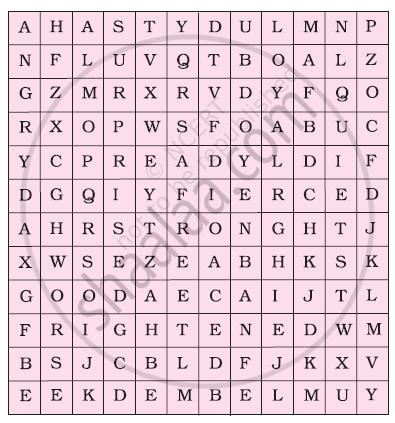
The cat was very happy to be on the ground. Pick out the phrase used to express this idea. - English

Advertisements
Advertisements

प्रश्न

The cat was very happy to be on the ground. Pick out the phrase used to express this idea.

एक पंक्ति में उत्तर
Advertisements

उत्तर

“Smiling and Smirking.”

shaalaa.com
Reading
  क्या इस प्रश्न या उत्तर में कोई त्रुटि है?
अध्याय 7.2: Dad and the Cat and the Tree - Working with the Poem [पृष्ठ ११०]

APPEARS IN

एनसीईआरटी English - Honeycomb Class 7
अध्याय 7.2 Dad and the Cat and the Tree
Working with the Poem | Q 5 | पृष्ठ ११०

संबंधित प्रश्न

This story about a frightening incident is narrated in a humorous way. What makes it
humorous? (Think of the contrasts it presents between dreams and reality. Some of them
are listed below.)
1. (i) The kind of person the doctor is (money, possessions)
(ii) The kind of person he wants to be (appearance, ambition)

2.(i) The person he wants to marry
(ii) The person he actually marries

3.(i) His thoughts when he looks into the mirror
(ii) His thoughts when the snake is coiled around his arm
Write short paragraphs on each of these to get your answer.


The Narrative Present
Notice the incomplete sentences in the following paragraphs. Here the writer is using incomplete sentences in the narration to make the incident more dramatic or immediate. Can you rewrite the paragraph in complete sentences?
(You can begin: The vet and I made a dash back to the car. Bruno was still floundering…)

(i) A dash back to car. Bruno still floundering about on his stumps, but clearly weakening rapidly; some vomiting, heavy breathing, with heaving flanks and gaping mouth. Hold him everybody! In goes the hypodermic – Bruno squeals – 10 c.c. of the antidote enters his system without a drop being wasted. Then minutes later: condition unchanged! Another 10 c.c. injected! Ten minutes later: breathing less stertorous – Bruno can move his arms and legs a little although he cannot stand yet. Thirty minutes later: Bruno gets up and has a great feed! He looks at us disdainfully, as much as to say, ‘What’s barium carbonate to a big black bear like me?’ Bruno is still eating.
(ii) In the paragraphs above from the story the verbs are in the present tense (eg. hold, goes, etc.). This gives the reader an impression of immediacy. The present tense is often used when we give a commentary on a game (cricket, football, etc.), or tell a story as if it is happening now. It is, therefore, called the narrative present. You will read more about the present tense in Unit 10


This poem describes the journey of a stream from its place of origin to the river that it joins. The poem has been written in the form of an autobiography where the brook relates its experiences as it flows towards the river. In Literature such a device by which an inanimate object is made to appear as a living creature is called Personification. Just as the brook has been personified in this poem, write a poem on any inanimate object making it come alive. You could begin with a poem of 6-8 lines. The poem should have a message. Maintain a rhyme scheme. Try and include similes, metaphors, alliteration etc. to enhance the beauty of the poem. You could write a poem on objects such as the candle/a tree/a rock/the desert etc.
This could be given as a homework activity. The teacher could read out some of the poems in the class and display the others.


Sometimes the choices we make have far-reaching consequences. Think about choices you make on a daily basis, and the importance of these choices.


What does he plant who plants a tree?
He plants cool shade and tender rain,
And seed and bud of days to be,
And years that fade and flush again;
He plants the glory of the plain;
He plants the forest's heritage;
The harvest of a coming age;
The joy that unborn eyes shall see___
These things he plants who plants a tree.

Read the lines given above and answer the question that follow:

Who is being referred to as the unborn eyes?


Some are Purple and gold flecked grey
For she who has journeyed through life midway,
Whose hands have cherished , whose love has blest,
And cradled fair sons on her faithful breast,
And serves her household in fruitful pride,
And worship the gods at her husband's side.

Read the lines given above and answer the question that follow:

What hues of bangles are cherished by a bride ? What are they symbolic of?


Its a cruel thing to leave her so.”

“Then take her to the poorhouse: she’ll have to go there,” answered the blacksmith’s wife, springing away, and leaving Joe behind.

For a little while the man stood with a puzzled air; then he turned back, and went into the hovel again. Maggie with painful effort, had raised herself to an upright position and was sitting on the bed, straining her eyes upon the door out of which all had just departed, A vague terror had come into her thin white face.

“O, Mr. Thompson!” she cried out, catching her suspended breath, “don’t leave me here all alone!”           ,

Though rough in exterior, Joe Thompson, the wheelwright, had a heart, and it was very tender in some places. He liked children, and was pleased to have them come to his shop, where sleds and wagons were made or mended for the village lads without a draft on their hoarded sixpences.

“No, dear,” he answered, in a kind voice, going to the bed, and stooping down over the child, “You she’n’t be left here alone.” Then he wrapped her with the gentleness almost of a woman, in the clean bedclothes which some neighbor had brought; and, lifting her in his strong arms, bore her out into the air and across the field that lay between the hovel and his home.

Read the extract given below and answer the question that follow.

Who said, ‘It’s a cruel thing to leave her so.’ Why did he say this?


It was the summer of 1936. The Olympic Games were being held in Berlin. Because Adolf Hitler childishly insisted that his performers were members of a “master race,” nationalistic feelings were at an all-time high.

I wasn’t too worried about all this. I’d trained, sweated and disciplined myself for six years, with the Games in mind. While I was going over on the boat, all I could think about was taking home one or two of those gold medals. I had my eyes especially on the running broad jump. A year before, as a sophomore at the Ohio State, I’d set the world’s record of 26 feet 8 1/4 inches. Nearly everyone expected me to win this event.

Read the extract given below and answer the question that follow.

Explain, ‘I wasn’t too worried about all this. I’d trained, sweated disciplined myself for six years with the game in the mind.


As it turned out, Luz broke his own past record. In doing so, he pushed me on to a peak performance. I remember that at the instant I landed from my final jump—the one which set the Olympic record of 26 feet 5-5/16 inches—he was at my side, congratulating me. Despite the fact that Hitler glared at us from the stands not a hundred yards away, Luz shook my hand hard—and it wasn’t a fake “smile with a broken heart” sort of grip, either.

You can melt down all the gold medals and cups I have, and they couldn’t be a plating on the 24-carat friendship I felt for Luz Long at that moment. I realized then, too, that Luz was the epitome of what Pierre de Coubertin, founder of the modern Olympic Games, must have had in mind when he said, “The important thing in the Olympic Games is not winning but taking part. The essential thing in life is not conquering but fighting well.”

Read the extract given below and answer the question that follow.

What, according to Coubertin, is the true spirit of the Olympics? Explain the reference to Coubertin.


From the third paragraph pick out

(i) words associated with cries of birds,

(ii) words associated with noise,

(iii) words suggestive of confusion and fear.


During the 1760 and 1770s, it became common to pitch the ball through the air. What changes it brought in to the game of cricket?


What is one thing that dreams can never tell?


Which phrase in the poem expresses Dad’s self-confidence best?


Complete the following sentence.
The small gray squirrel became friendly when _________


Answer the following question.
When Jumman’s aunt realised that she was not welcome in his house, what arrangement did she suggest?


Answer the following question.
 “God lives in the heart of the Panch.” the aunt said. What did she mean? 


Answer the following question.
What was Jumman’s verdict as head Panch? How did Algu take it?


  • Notice the way Mr Gessler speaks English. His English is influenced by his mother tongue. He speaks English with an accent.
  • When Mr Gessler speaks, p, t, k, sound like b,d,g. Can you say these words as Mr Gessler would say them?
    It comes and never stops. Does it bother me? Not at all. Ask my brother, please.

Complete the following sentence by providing a reason:

In the short story, The Sound Machine, Dr. Scott thought Klausner was ill when Klausner rang up the doctor because ______.


Tarapada, the central character in the short story, Atithi, is a free soul who cannot be restrained by the bonds of society. Examine this statement in 200-250 words.


Share
Notifications

Englishहिंदीमराठी


      Forgot password?
Use app×