Advertisements
Advertisements
प्रश्न
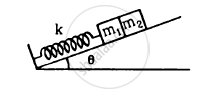
The block of mass m1 shown in figure is fastened to the spring and the block of mass m2 is placed against it. (a) Find the compression of the spring in the equilibrium position. (b) The blocks are pushed a further distance (2/k) (m1 + m2)g sin θ against the spring and released. Find the position where the two blocks separate. (c) What is the common speed of blocks at the time of separation?
Advertisements
उत्तर
(a) As it can be seen from the figure,
Restoring force = kx
Component of total weight of the two bodies acting vertically downwards = (m1 + m2) g sin θ
At equilibrium,
kx = (m1 + m2) g sin θ
\[\Rightarrow x = \frac{\left( m_1 + m_2 \right) g \sin \theta}{k}\]
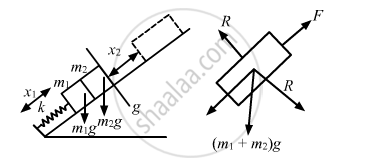
(b) It is given that:
Distance at which the spring is pushed,
\[x_1 = \frac{2}{k}\left( m_1 + m_2 \right)g \sin \theta\]
As the system is released, it executes S.H.M.
where \[\omega = \sqrt{\frac{k}{m_1 + m_2}}\]
When the blocks lose contact, P becomes zero. (P is the force exerted by mass m1 on mass m2)
\[\therefore m_2 g \sin \theta = m_2 x_2 \omega^2 = m_2 x_2 \times \frac{k}{m_1 + m_2}\] \[ \Rightarrow x_2 = \frac{\left( m_1 + m_2 \right) g \sin \theta}{k}\]
Therefore, the blocks lose contact with each other when the spring attains its natural length.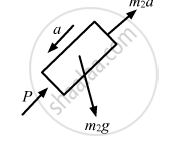
(c) Let v be the common speed attained by both the blocks.
\[\text { Total compression } = x_1 + x_2 \]
\[\frac{1}{2} \left( m_1 + m_2 \right) v^2 - 0 = \frac{1}{2}k \left( x_1 + x_2 \right)^2 - \left( m_1 + m_2 \right) g \sin \theta \left( x + x_1 \right) \]
\[ \Rightarrow \frac{1}{2}\left( m_1 + m_2 \right) v^2 = \frac{1}{2}k\left( \frac{3}{k} \right) \left( m_1 + m_2 \right) g \sin \theta - \left( m_1 + m_2 \right) g \sin \theta \left( x_1 + x_2 \right)\]
\[ \Rightarrow \frac{1}{2}\left( m_1 + m_2 \right) v^2 = \frac{1}{2} \left( m_1 + m_2 \right) g \sin \theta \times \left( \frac{3}{k} \right) \left( m_1 + m_2 \right) g sin \theta\]
\[ \Rightarrow v = \sqrt{\left\{ \frac{3}{k} \left( m_1 + m_2 \right) \right\}}g \sin \theta\]
APPEARS IN
संबंधित प्रश्न
A particle is in linear simple harmonic motion between two points, A and B, 10 cm apart. Take the direction from A to B as the positive direction and give the signs of velocity, acceleration and force on the particle when it is
(a) at the end A,
(b) at the end B,
(c) at the mid-point of AB going towards A,
(d) at 2 cm away from B going towards A,
(e) at 3 cm away from A going towards B, and
(f) at 4 cm away from B going towards A.
The equation of motion of a particle started at t = 0 is given by x = 5 sin (20t + π/3), where x is in centimetre and t in second. When does the particle
(a) first come to rest
(b) first have zero acceleration
(c) first have maximum speed?
Consider a particle moving in simple harmonic motion according to the equation x = 2.0 cos (50 πt + tan−1 0.75) where x is in centimetre and t in second. The motion is started at t = 0. (a) When does the particle come to rest for the first time? (b) When does he acceleration have its maximum magnitude for the first time? (c) When does the particle come to rest for the second time ?
The pendulum of a clock is replaced by a spring-mass system with the spring having spring constant 0.1 N/m. What mass should be attached to the spring?
A block of mass 0.5 kg hanging from a vertical spring executes simple harmonic motion of amplitude 0.1 m and time period 0.314 s. Find the maximum force exerted by the spring on the block.
Find the elastic potential energy stored in each spring shown in figure, when the block is in equilibrium. Also find the time period of vertical oscillation of the block.
A 1 kg block is executing simple harmonic motion of amplitude 0.1 m on a smooth horizontal surface under the restoring force of a spring of spring constant 100 N/m. A block of mass 3 kg is gently placed on it at the instant it passes through the mean position. Assuming that the two blocks move together, find the frequency and the amplitude of the motion.
Discuss in detail the energy in simple harmonic motion.
Show that for a particle executing simple harmonic motion.
- the average value of kinetic energy is equal to the average value of potential energy.
- average potential energy = average kinetic energy = `1/2` (total energy)
Hint: average kinetic energy = <kinetic energy> = `1/"T" int_0^"T" ("Kinetic energy") "dt"` and
average potential energy = <potential energy> = `1/"T" int_0^"T" ("Potential energy") "dt"`
If a body is executing simple harmonic motion and its current displacements is `sqrt3/2` times the amplitude from its mean position, then the ratio between potential energy and kinetic energy is:
A body is executing simple harmonic motion with frequency ‘n’, the frequency of its potential energy is ______.
A body is executing simple harmonic motion with frequency ‘n’, the frequency of its potential energy is ______.
A body is executing simple harmonic motion with frequency ‘n’, the frequency of its potential energy is ______.
Motion of an oscillating liquid column in a U-tube is ______.
Displacement versus time curve for a particle executing S.H.M. is shown in figure. Identify the points marked at which (i) velocity of the oscillator is zero, (ii) speed of the oscillator is maximum.

Find the displacement of a simple harmonic oscillator at which its P.E. is half of the maximum energy of the oscillator.
A mass of 2 kg is attached to the spring of spring constant 50 Nm–1. The block is pulled to a distance of 5 cm from its equilibrium position at x = 0 on a horizontal frictionless surface from rest at t = 0. Write the expression for its displacement at anytime t.
A particle undergoing simple harmonic motion has time dependent displacement given by x(t) = A sin`(pit)/90`. The ratio of kinetic to the potential energy of this particle at t = 210s will be ______.
