Advertisements
Advertisements
प्रश्न
The animals’ reaction to the nightingale’s song caused the frog to ______.
विकल्प
turn a blind eye
be green with envy
drive himself up the wall
turn blue in the face
Advertisements
उत्तर
The animals’ reaction to the nightingale’s song caused the frog to be green with envy.
APPEARS IN
संबंधित प्रश्न
MarkMarkListed below are some character traits of people. A few of these are positive qualities, while others are not. Tick mark the ones you feel are desirable qualities in a person.
| Characteristic | Tick Mark | Characteristic | Tick Mark | Characteristic | Tick Mark |
| Insensitive | High - headed | Manipulative | |||
| Humorous | Egoistic | Patronizing | |||
| Naïve | Humble | Submissive | |||
|
Opportunistic |
Foolish | Arrogant | |||
| Creative | Original | Conniving | |||
| Disapproving | Helpful | Innocent | |||
| Commanding | Calculative | Condescending | |||
| Benevolent | Crafty | Scheming | |||
| Simple | Wise | Rude | |||
| Overbearing | Generous | Boastful | |||
| Sly | Gentle | Proud | |||
| Territorial | Aggressive | Servile |
Have you come across people who are not what they seem to be - like someone who is extremely friendly and helpful yet you are not very comfortable with him / her as you feel it is a put-on? Have a class discussion about such people and why you feel as you do.
Before you read the poem complete the word - web with the words that we associate with a Frog and a Nightingale
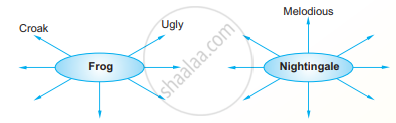
Now that you have read the poem, add more personality traits to the word-web of the frog and the nightingale as depicted in the poem. Then complete the given table. (Some of the words in the box below may help you. You may also use the words given in Q. 1.)
| Character | Extract | Personality traits |
| Nightingale | Sorry - was that you who spoke? | Polite, Timorous |
| Frog |
Yes,… you see, I'm the frog who owns this tree In this bog I've long been known For my splendid baritone. |
|
| Nightingale | Did you…did you like my song? | |
| Frog | Not too bad - but far too long The technique was fine, of course, But it lacked a certain force. | |
| Frog | Without proper training such as I And a few others can supply You'll remain a mere beginner, But with me you'll be a winner. | |
| Nightingale | But I can't sing in this weather | |
| Nightingale | …This is a fairy tale - And you're Mozart in disguise Come to earth before my eyes. | |
| Frog | Come, my dear - we'll sing together. | |
| Frog | We must aim for better billing You still owe me sixty shillings. |
|
| Frog | Brainless bird - you're on the stage Use your wits and follow fashion. Puff your lungs out with your passion. | |
| Frog | …I tried to teach her, But she was a stupid creature. |
| Dismissive Nervous Timid Presumptuous Superior Fawning Shy Polite Meek Possessive Dominating Mercenery |
Divide yourselves into groups of four or five and brainstorm on any one of the given situations in order to create an imaginary dialogue or a comic strip. Keep in mind the characters and situations while doing so. Representatives from each group could then present the dialogues / read them to the class.
| Situations a. The efforts made by the other creatures of the bog to still the frog's determination 'to display his heart's elation'. b. The first time the Nightingale sings. c. The nightingale is awestruck when the frog introduces himself. d. The practice session when it is raining. e. The nightingale is reprimanded by the frog when the box office crashes. |
The frog’s ultimate aim was to ______.
Which are the different ways in which the frog asserts his importance?
Answer the following question briefly.
Why is the frog's joy both sweet and bitter?
Discuss the following question and write the answer in your note-books.
Do you think the nightingale is 'brainless'? Give reasons for your answer.
Discuss the following question and write the answer in your note-books.
Inspite of having a melodious voice and being a crowd puller, the nightingale turns out to be a loser and dies. How far is she responsible for her own downfall?
Discuss the following question and write the answer in your note-books.
Do you agree with the Frog's inference of the Nightingale's character? Give reasons for your answer.
Write an obituary for the nightingale. You may begin like this: May the kind soul……… (or you may make use of your own beginning)
Listen to your teacher recite the poem The Spider and the Fly by Mary Howitt and compare the Fly to Vikram Seth's Nightingale.
Even though both, the frog from Vikram Seth’s poem, The Frog and the Nightingale and Abel's children from the play, The Dear Departed, display greed, there are differences. Elaborate, in about 150 words, how the greed of the frog and that of Abel's children differ in motivation, actions, relationship, and consequences.
