Advertisements
Advertisements
प्रश्न
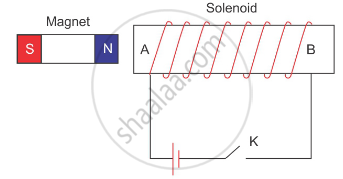
The adjacent diagram shows a small magnet placed near a solenoid AB. Current is switched on in the solenoid by pressing the key K.
- State the polarity at the ends A and B.
- Will the magnet be attracted or repelled? Give a reason for your answer.
The diagram in figure shows a small magnet placed near a solenoid AB with its north pole N near the end A. Current is switched on in the solenoid by pressing the key K.
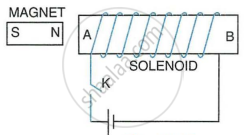
- State the polarity at the ends A and B.
- Will the magnet be attracted or repelled ? Give a reason for your answer
Advertisements
उत्तर
- A - North Pole, B - South Pole.
- The magnet will be repelled because the end of the solenoid near the north pole of the magnet becomes the north pole as the current at this face is anticlockwise and the two like poles repel.
APPEARS IN
संबंधित प्रश्न
Why does a current carrying, freely suspended solenoid rest along a particular direction?
State the direction in which current-carrying freely suspended solenoid rests
The following diagram shows a spiral coil wound on a hollow carboard tube AB. A magnetic compass is placed close to it. Current is switched on by closing the key.
- What will be the polarity at the ends A and B?
- How will the compass needle be affected? Give reason.

Why does a current carrying freely suspended solenoid rest along a particular direction? State the direction in which it rests.
A current carrying solenoid behaves like a ______.
- What name is given to a cylindrical coil of diameter less than its length?
- If a piece of soft iron is placed inside the coil mentioned in part (a) and current is passed in the coil from a battery, what name is then given to the device so obtained?
- Give one use of the device mentioned in part (b).
The magnetic field lines outside a bar magnet:
Which of the following diagrams correctly shows the magnetic field produced by a current-carrying wire?
The pattern of the magnetic field produced by the straight current-carrying conducting wire is ____________.
Differentiate between a circular coil and a solenoid.
