Advertisements
Advertisements
प्रश्न
Tell any one of the stories orally imagining you are Gulliver.
Advertisements
उत्तर
|
Gulliver’s Adventure in Lilliput I remember it like it was yesterday. I had set sail on a ship called the Antelope, hoping for a simple sea journey, but fate had other plans. After weeks of harsh storms, our ship hit the rocks, and I was thrown into the sea. Somehow, I swam ashore and crawled up on a strange beach, exhausted. I collapsed into a deep sleep. When I awoke, I couldn’t believe my eyes! My arms, legs, and hair were tied down with tiny ropes. I looked around and saw hundreds—no, thousands—of tiny people, no taller than my thumb, standing all around me, looking frightened but curious. They had strange little weapons—tiny bows and arrows—and shouted in their squeaky language. I was Gulliver, a giant in the land of Lilliputians! At first, I struggled, but the tiny ropes held me firmly in place. Eventually, the Lilliputians realized I meant no harm, so they brought me food—tiny pieces of bread and barrels of wine, which felt like drops to me! Slowly, I gained their trust, and the Emperor of Lilliput even invited me to his court. However, life in Lilliput wasn’t easy. These little people had strange customs and rules. One of the biggest problems was that the Lilliputians were constantly at war with their neighbours, the Blefuscudians, over something as silly as which end of an egg should be broken first! One day, they asked me for a favour. The Emperor ordered me to help them in their war. I waded across the sea to Blefuscu, pulling all of their enemy ships with ropes—like a child playing with toy boats! The Lilliputians celebrated me as a hero, but soon I realized that I couldn’t stay. Their jealous ministers were plotting against me, and I knew my size made me both a friend and a threat in their tiny world. So, I managed to escape on a boat I found washed ashore. Though my adventure in Lilliput had ended, I knew this was only the beginning of many strange journeys yet to come. |
संबंधित प्रश्न
Read the following passage and do the activities:
B1 Match:
Match the areas given in Column ‘A’ with the description of Mehendi design given in Column ‘B’:
| 'A' | 'B" | ||
| (i) | North African | (a) | A mix of Indo-Pakistani and Arabic design |
| (ii) | Indian | (b) | Delicate loops and curves, paisleys, teardrops |
| (iii) | Arabic | (c) | Geometrical images |
| (iv) | South Asian | (d) | Local textiles, paintings, and architecture |
Henna comes from the leaves of the plant Lawsonia inertias. The plant grows in hot and dry climes and is native to North Africa, the Indian subcontinent and the Middle East. The leaves of the plant are dried and crushed to powder. Various additives such as coffee decoction, tea, lime juice, Mehendi and eucalyptus oil are mixed with the henna powder to increase the potency of the dry, this also helps to bind the powder to a paste-like consistency. The mixture is applied through cones in intricate patterns depending on the region of use.
Album of Patterns
Four major styles can be found in the vast dictionary of Mehendi designs. Earlier the application was restricted to hand and feet, but the adoption of Mehendi by different cultures throughout the world has seen experimentation on different body parts including the neck naval and back.
North African patterns rely on geometrical images to trace the shape of hands and feet, Arabic designs borrow heavily from local textiles, paintings, and architecture. These are more spaced out, to allow the design to stand out boldly from the skin parts left untouched by henna. The Indian style comprises of delicate loops and curves, paisleys, teardrops and flowers that give a dainty filigreed glow-like effect. Though intricate patterning is the name of the game today, this trend took off in India only during the 20th century. The patterns preferred by the South Asian countries are mixed with Indo-Pakistani and Arabic design schemes. Chinese and Celtic symbols now find a place in the vast repertoire of Mehendi designs as well.
B2 Complete:
Complete the following and write:
(i) The procedure before applying henna _______
(ii) The reasons for using additives _______
(iii) The suitable climatic conditions for the henna plant _______
(iv) Mehendi is used on _______
B3 Find words:
Look at the following description and find out proper words from the passage and write:
(i) Existing naturally in the place : - n _______
(ii) Consist of something: - c _______
(iii) Delicate decoration made from gold, silver and copper wire: - f _______
(iv) Substance that is added in small quantity : - a _______
B4 Language study:
Fill in the blanks with suitable subordinators given in the box:
| as well as, so that, however, which |
(i) The mixture is applied through cones in intricate patterns _______ depend on the region of use.
(ii) The intricate pattern is the name of the game of today _______, this trend took off in India, recently.
(iii) North African pattern relies on geometrical images ______ they can trace the shape of hands and feet.
(iv) The patterns preferred by the South Asian countries are mixed with Indo-Pakistani _______ Arabic design schemes.
B5 Personal Response:
Which Mehendi design do you like? Why?
Answer in your own words.
Why did the old man have no need to build the bridge, across the chasm?
Write a short note on the following:
The living world on Rakata
Discuss the following questions after you have seen a presentation of the ‘ad’.
Can you become fair in five days? How long will the effect of the cream last?
Write a short note on the following:
Veterinary Science in Ancient India.
Answer the following question in about 100-150 word.
Narrate the extensive search operation made by the policemen in the house.
Read the comic strip and answer the following question.
Which website do you often access? Why?
Why was the fish floating on top?
Choose the correct answer.

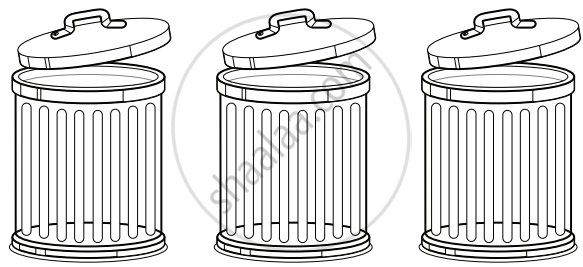
Read the passage three times and colour a dustbin each time.
|
I am Mani. I had to take a bus to nearby city. I crossed the road to reach the bus stand. I got the bus, sat down, and read a book. Before I started to read, I just looked at the people around me. The two men sitting next to me were talking loudly. Some were listening to music on their phone. I was unable to focus on reading. The men were talking about cleaning the city. As they were talking, they opened a pack of biscuits to eat. After some time I dozed off. When I opened my eyes, the bus had reached the city. The two men were not there but pieces of the biscuits and wrappers were there. I cleaned the wrappers and put them in the dustbin.
|
- What did Mani take out?
- What did Mani find on the seat when he woke up?
- If you were Mani, what would you do?
