Advertisements
Advertisements
प्रश्न
Advertisements
उत्तर
The current flowing through a conductor is directly proportional to the potential difference across its ends, provided the temperature and other physical conditions remain constant.
According to Ohm’s law, the current flowing in a conductor is directly proportional to the potential difference across its ends provided the physical conditions and temperature of conductor remains constant.
APPEARS IN
संबंधित प्रश्न
If 20 C of charge pass a point in a circuit in 1 s, what current is flowing?
What is an electric current?
The figure given below shows an electric circuit in which current flows from a 6 V battery through two resistors.
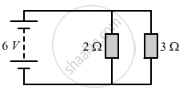
- Are the resistors connected in series with each other or in parallel?
- For each resistors, state the p.d. across it.
- The current flowing from the battery is shared between the two resistors. Which resistor will have bigger share of the current?
- Calculate the effective resistance of the two resistors.
- Calculate the current that flows from the battery.
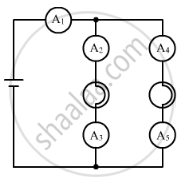
If the lamps are both the same in the figure given below and if A1 reads 0.50 A, what do A2, A3, A4 and A5 read?
Define the term resistivity.
Match the pairs.
| ‘A’ Group | ‘B’ Group |
| 1. Free electrons | a. V/R |
| 2. Current | b. Increases the resistance in the circuit |
| 3. Resistivity | c. Weakly attached |
| 4. Resistances in series | d. VA/LI |
A bulb marked 12 V, 24 W operates on a 12 volt car battery for 20 minutes. Calculate:
(i) The current flowing through it, and
(ii) The energy liberated.
An electric bulb is marked 100 W, 250 V. How much current will the bulb draw if connected to a 250 V supply?
Which of the following represents voltage?
