Solve the following system of equations by the method of cross-multiplication: (x + y)/(xy) = 2 (x – y)/(xy) = 6
Advertisements
प्रश्न
Solve the following system of equations by the method of cross-multiplication:
`(x + y)/(xy) = 2`
`(x - y)/(xy) = 6`
Advertisements
उत्तर
The given system of equations is
`(x + y)/(xy) = 2`
`=> x/(xy) + y/(xy) = 2`
`=> 1/y + 1/x = 2`
`=> 1/x + 1/y = 2` ............(i)
And
`(x - y)/(xy) = 6`
`=> x/(xy) - y/(xy) = 6`
`=> 1/y - 1/x = 6`
`=> 1/x - 1/y = 6` ......(ii)
Taking `u = 1/x and v = 1/y` we get
`u + v = 2 => u + v - 2 = 0` ....(iii)
And u - v = -6 => u - v + 6 = 0 ........(iv)
Here
`a_1 = 1, b_1 = 1,c_1 = -2`
`a_2 = 1, b_2 = -1, c_2 = 6`
By cross multiplication
`=> u/(1xx6-(-2)xx(-1)) = v/(1xx6-(-2)xx1) = 1/(1xx(-1) -1 xx1)`
`=> u/(6-2) = (-v)/(6+2) = 1/(-1-1)`
`=> u/4 = (-v)/8 = 1/(-2)`
Now, `u/4 = 1/(-2)`
`=> u = 4/(-2) = -2`
And `(-v)/8 = 1/(-2)`
`=> -v = 8/(-2) = -4`
`=> -v = -4`
`=> v = 4`
Now `x = 1/u = (-1)/2, y = 1/v = 1/4`
Hence `x = (-1)/2, y = 1/4 `is the solution of the given system of equations.
APPEARS IN
संबंधित प्रश्न
Solve the following system of equations by cross-multiplication method.
ax + by = a – b; bx – ay = a + b
Solve the following system of equations by cross-multiplications method.
`a(x + y) + b (x – y) = a^2 – ab + b^2`
`a(x + y) – b (x – y) = a^2 + ab + b^2`
Which of the following pairs of linear equations has unique solution, no solution or infinitely many solutions? In case there is a unique solution, find it by using cross multiplication method
2x + y = 5
3x + 2y = 8
Solve the following system of equations:
0.5x + 0.7y = 0.74
0.3x + 0.5y = 0.5
Solve the following systems of equations:
`10/(x + y) + 2/(x - y) = 4`
`15/(x + y) - 5/(x - y) = -2`
Solve each of the following systems of equations by the method of cross-multiplication :
x + 2y + 1 = 0
2x − 3y − 12 = 0
Solve each of the following systems of equations by the method of cross-multiplication
`x/a + y/b = 2`
`ax - by = a^2 - b^2`
Solve each of the following systems of equations by the method of cross-multiplication :
2ax + 3by = a + 2b
3ax + 2by = 2a + b
Solve the following system of equations by the method of cross-multiplication:
5ax + 6by = 28
3ax + 4by = 18
Solve each of the following systems of equations by the method of cross-multiplication :
`x(a - b + (ab)/(a - b)) = y(a + b - (ab)/(a + b))`
`x + y = 2a^2`
Solve the following system of equations by the method of cross-multiplication:
bx + cy = a + b
`ax(1/(a - b) - 1/(a + b)) + cy(1/(b - a) - 1/(b + a)) = (2a)/(a + b)`
Solve the following system of equations by the method of cross-multiplication:
2(ax – by) + a + 4b = 0
2(bx + ay) + b – 4a = 0
Solve the following system of equations by the method of cross-multiplication:
`a^2/x - b^2/y = 0`
`(a^2b)/x + (b^2a)/y = a + b, x, y != 0`
Solve the following system of equations by the method of cross-multiplication:
`(ax)/b - (by)/a = a + b`
ax – by = 2ab
Solve the system of equations by using the method of cross multiplication:
2x + y – 35 = 0, 3x + 4y – 65 = 0
Find the values of x and y in the following rectangle [see figure].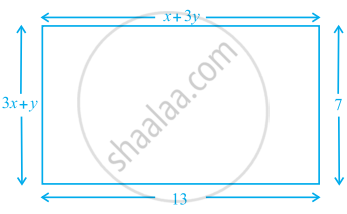
Solve the following pair of equations:
`x/a + y/b = a + b, x/a^2 + y/b^2 = 2, a, b ≠ 0`
A two-digit number is obtained by either multiplying the sum of the digits by 8 and then subtracting 5 or by multiplying the difference of the digits by 16 and then adding 3. Find the number.
For what values of k will the following pair of linear equations have infinitely many solutions?
kx + 3y – (k – 3) = 0
12x + ky – k = 0
