Advertisements
Advertisements
प्रश्न
Solve the following quadratic equation by factorisation method:
`x/(x + 1) + (x + 1)/x = (34)/(15') x ≠ 0, x ≠ -1`
Advertisements
उत्तर
We have
`x/(x + 1) + (x + 1)/x = (34)/(15)`
⇒ `(x^2 + (x + 1)^2)/(x(x +1)) = (34)/(15)`
⇒ `(x^2 + x^2 + 1 + 2x)/(x^2 + x) = (34)/(15)`
⇒ `(2x^2 + 2x + 1)/(x2 + x) = (34)/(15)`
⇒ 34x2 + 34x = 30x2 + 30x + 15
⇒ 4x2 + 4x - 15 = 0
⇒ 4x2 + 10x - 6x - 15 = 0
⇒ 2x(2x + 5) -3(2x + 5) = 0
⇒ (2x + 5) (2x - 3) = 0
⇒ 2x + 5 = 0 or 2x - 3 = 0
⇒ 2x = -5 and 2x = 3
⇒ x = `-(5)/(2), x = (3)/(2)`.
संबंधित प्रश्न
Solve the following quadratic equations by factorization:
`5/(x - 2) - 3/(x + 6) = 4/x`
Solve the following quadratic equations by factorization:
\[\frac{3}{x + 1} + \frac{4}{x - 1} = \frac{29}{4x - 1}; x \neq 1, -1, \frac{1}{4}\]
Find the values of p for which the quadratic equation \[\left( 2p + 1 \right) x^2 - \left( 7p + 2 \right)x + \left( 7p - 3 \right) = 0\] has equal roots. Also, find these roots.
A two digit number is such that the product of the digits is 14. When 45 is added to the number, then the digit are reversed. Find the number.
A shopkeeper purchases a certain number of books for Rs. 960. If the cost per book was Rs. 8 less, the number of books that could be purchased for Rs. 960 would be 4 more. Write an equation, taking the original cost of each book to be Rs. x, and Solve it to find the original cost of the books.
Solve the following equation by factorization
(x – 4)2 + 52 = 132
The length of a rectangle exceeds its breadth by 5 m. If the breadth were doubled and the length reduced by 9 m, the area of the rectangle would have increased by 140 m². Find its dimensions.
Divide 16 into two parts such that the twice the square of the larger part exceeds the square of the smaller part by 164.
The length of a rectangular garden is 12 m more than its breadth. The numerical value of its area is equal to 4 times the numerical value of its perimeter. Find the dimensions of the garden.
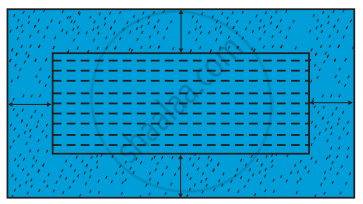
In the centre of a rectangular lawn of dimensions 50 m × 40 m, a rectangular pond has to be constructed so that the area of the grass surrounding the pond would be 1184 m2 [see figure]. Find the length and breadth of the pond.