Advertisements
Advertisements
प्रश्न
Play detectives with each other. Find a person in your class (or some other acquaintance) to speak to. Find out the answers to the questions given below. Be careful to ask your questions in a polite and inoffensive way. Do not force the person to answer you. Then allow the person to ask you the same questions.
- Name?
- What newspapers or magazines does the person read?
- How long has the person lived at the current address?
- What does she/he do during the day, i.e. the daily routine?
- What do neighbours and friends say about the person?
- Who are his/her visitors and what are his/her eating habits? (You can ask a few others about this.)
- What do you think about the person?
Advertisements
उत्तर
Do it yourself.
संबंधित प्रश्न
Why does grandfather take Toto to Saharanpur and how? Why does the ticket collector insist on calling Toto a dog?
In what way is Iswaran an asset to Mahendra?
Answer the following question in one or two sentences.
How did Abdul Kalam earn his first wages?
Both, all, neither, none
| One | Of them | |
| Two | ||
| Three | is a ... | |
| Neither | are ... s. | |
| All | ||
| None | ||
| Both |
Bangle sellers are we who bear
Our shining loads to the temple fair...
Who will buy these delicate, bright
Rainbow-tinted circles of light?
Lustrous tokens of radiant lives,
For happy daughters and happy wives.
Read the lines given above and answer the question that follow.
What is referred to Rainbow-tinted circles of light ?
It was a summer evening,
Old Kaspar's work was done,
And he before his cottage door
Was sitting in the sun,
And by him sported on the green
His little grandchild Wilhelmine.
She saw her brother Peterkin
Roll something large and round,
Which he beside the rivulet
In playing there had found;
He came to ask what he had found,
That was so large, and smooth, and round.
Read the lines given above and answer the question that follow.
Explain with reference to context.
From the day, perhaps a hundred years ago when he sun had hatched him in a sandbank, and he had broken his shell, and got his head out and looked around, ready to snap at anything, before he was even fully hatched-from that day, when he had at once made for the water, ready to fend for himself immediately, he had lived by his brainless craft and ferocity. Escaping the birds of prey and the great carnivorous fishes that eat baby crocodiles, he has prospered, catching all the food he needed, and storing it till putrid in holes in the bank. Tepid water to live in and plenty of rotted food grew him to his great length. Now nothing could pierce the inch-?thick armoured hide. Not even rifle bullets,
which would bounce off. Only the eyes and the soft underarms offered a place. He lived well in the river, sunning himself sometimes with other crocodiles-muggers, as well as the long-? snouted fish-?eating gharials-on warm rocks and sandbanks where the sun dried the clay on them quite white, and where they could plop off into the water in a moment if alarmed. The big crocodile fed mostly on fish, but also on deer and monkeys come to drink, perhaps a duck or two.
Read the extract given below and answer the question that follow.
What did the big crocodile feed on?
Then there it lay in her wet palm, perfect, even pierced ready for use, with the sunset shuffled about inside it like gold—?dust. All her heart went up in flames of joy. After a bit she twisted it into the top of her skirt against her tummy so she would know if it burst through the poor cloth and fell. Then she picked up her fork and sickle and the heavy grass and set off home. Ai! Ai! What a day! Her barefeet smudged out the wriggle— ?mark of snakes in the dust; there was the thin singing of malaria mosquitoes among the trees now; and this track was much used at night by a morose old makna elephant—the Tuskless One; but Sibia was not thinking of any of them. The stars came out: she did not notice. On the way back she met her mother, out of breath, come to look for her, and scolding. “I did not see till I was home, that you were not there. I thought something must have happened to you.” And Sibia, bursting with her story, cried “Something did). I found a blue bead for my necklace, look!”
Read the extract given below and answer the question that follow.
Why did Sibia not tell her mother about her fight with the crocodile or how she saved the woman?
Read the following passage carefully and answer the questions that follow:
Granny knew I'd been in the train for two nights, and she had a huge breakfast ready for me. Later she told me there'd been a letter from Uncle Ken.
'He says he's the manager in Fitpo's hotel in Simla,' she said. 'The salary is very good. It's a steady job and I hope he keeps it.' Three days later Uncle Ken was on the veranda steps with his bedding roll and battered suitcase. 'Have you given up the hotel job?' asked Granny. 'No,' said Uncle Ken. 'They have closed down.' I hope it wasn't because of you.' 'No, Aunt Ellen_ The bigger hotels in the hill stations are closing down. 'Well, never mind. Come along and have your lunch. Over lunch; Uncle Ken talked very seriously about ways and means of earning a living. There is only one taxi in the whole of Debra, he mused. 'Surely there is business for another?' `I'm sure there is,' said Granny. 'But where does it get you? In the first place, you don't have a taxi. And in the second place, you can't drive.' I can soon learn. There's a driving school in town. And I can use Uncle's old car.' 'I don't think it will run now,' said Granny. 'Of course, it will. It just needs some oiling and greasing and a spot of paint.' 'All right, learn to drive.' So, Uncle Ken joined the driving school.After a month Uncle Ken announced that he could drive and that he was taking the car out for a trial run. 'You haven't got your license yet,' said Granny. 'Oh, I won't take it far,' said Uncle Ken. 'Just down the road and back again.' He spent all morning cleaning up the car. Granny gave him money for a can of petrol. After tea, Uncle Ken said, 'Come along, Ruskin, hop in and I will give you a ride. Bring Mohan along too.' Mohan and I needed no urging. We got into the car beside Uncle Ken. 'Now don't go too fast, Ken,' said Granny anxiously. 'You are not used to the car as yet.' Uncle Ken nodded and smiled and gave two sharp toots on the horn. He was feeling pleased with himself. Driving through the gate, he nearly ran over a cat. Miss Kellner, coming out for her evening rickshaw ride, saw Uncle Ken at the wheel of the car and ran indoors again. [40] Uncle Ken drove straight and fast, tootling the horn without a break. At the end of the road there was a roundabout. 'We’ll turn here,' said Uncle Ken, 'and then drive back again.' He turned tt;e steering wheel, we began going round the roundabout, but the steering wheel wouldn't turn all the way, not as much as Uncle Ken would have liked it to... So, instead he went on - and straight through the Maharaja of Jetpur’s garden wall. It was a single-brick wall, and the car knocked it down and emerged on the other, side without any damage to the car or any of its occupants. Uncle Ken brought it to a halt in the middle of the Maharaja's lawn. Running across the grass came the Maharaja himself. When he saw that it was Uncle Ken at the wheel, the Maharaja beamed with pleasure. 'Delighted to see you, old chap!' he exclaimed. 'Jolly decent of you to drop in again. How about a game of tennis?'
(a) Give the meaning of the following words as used in the passage:
One word answers or short phrases will be accepted.
(i) battered
(ii) bused
(iii) emerged
(b) Answer the following questions briefly in your own words.
(i) Why did Granny hope Uncle Ken would keep his job at Fitgo's hotel?
(ii) When Uncle Ken arrived with his luggage, Granny remarked that she hoped the hotel had not closed down because of him. What does this remark tell you about Uncle Ken?
(iii) Why did Uncle Ken think that driving a taxi in Dehra would be profitable?
(iv) Which sentence tells you that the narrator and his friend were waiting to be invited for a drive in a car?
(v) Why did Miss Kellner run indoors when she saw Uncle Ken at the wheel of the car?
(vi) What was Uncle Ken's intention at the roundabout?
(c)
(I) In not more than 60 words, describe what happened after the car went through the wall.
(ii) Give a title to your summary in 3(c)(i). Give a reason to justify choice of the title.
What, according to this speaker, is the only true religion in the world? What human qualities have I been highlighted through 'his' speech?
The following sentence has two blanks. Fill in the blanks with appropriate forms of the word given in bracket.
It’s a fairly simple question to__________,butwill you accept my________ as final? (answer)
Who finds it difficult to imagine what a desert is Uke?
Was he successful in saving the cat the second time?
(i) Like Patrick in the story ‘Who Did Patrick’s Homework’, Taro is helped by magic. Do you believe in magic? What are the magical things that happen in these stories?
(ii) Which story do you like better, and why? Do you know such stories in other languages? Discuss these questions in class.
What exciting scene did the author enjoy from his platform in the banyan tree?
Multiple Choice Question:
Such silly questions are baseless, still ______
Answer the following question:
An old man won a clock and sold it back to the shopkeeper. How much money did he make?
Look at the following picture. One asks a question, the other answers it. Then the answer is noted in a form as shown below.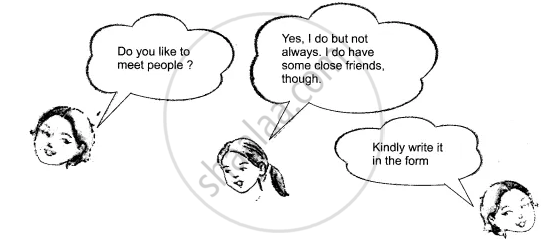
| Questions | Yes/No | Additional Response |
|
1. Do you like to meet people? |
Yes I do, but not always | I do have some close friends, though. |
|
2. Do you like the area you live in? |
No, I Don't | But I have no choice |
How does Prospero ask to be to be released from his “bands” in the Epilogue of the play, The Tempest?
Read the two statements from the short story, The Cookie Lady and choose the correct option from the ones given below.
Statement I: “Why don’t you read to me from your books? You know I don’t see too well anymore and it’s comfort to me to be read to.”
Statement II: “You don’t mind if I touch your arm, do you?”
