Advertisements
Advertisements
प्रश्न
One end of a 10 cm long silk thread is fixed to a large vertical surface of a charged non-conducting plate and the other end is fastened to a small ball of mass 10 g and a charge of 4.0× 10⁻⁶ C. In equilibrium, the thread makes an angle of 60° with the vertical. Find the surface charge density on the plate.
Advertisements
उत्तर
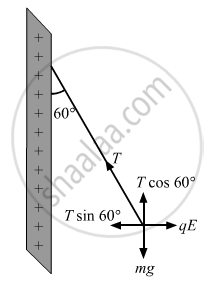
There are two forces acting on the ball. These are
(1) Weight of the ball, W = mg
(2) Coulomb force acting on the charged ball due to the electric field of the plate, F = qE
Due to these forces,a tension develops in the thread.
Let the surface charge density on the plate be σ.
Electric field of a plate,
`"E" = sigma /(2∈_0)`
It is given that in equilibrium, the thread makes an angle of 60° with the vertical.
Resolving the tension in the string along horizontal and vertical directions, we get:
T cos 60° = mg
T sin 60° = qE
`=> tan 60° = "qE"/"mg"`
`=> "E" = ("mg" tan 60 °)/q`
Also, electric field due to a plate,
`"E" = sigma/ 2 ∈_0 =( "mg" tan 60°)/q`
`sigma =(2 ∈_0 "mg" tan 60 °)/"q"`
`sigma =( 2 xx (8.55 xx 10^-12 ) xx ( 10 xx 10 ^-3 xx 9.8) xx 1.7320)/(4.0 xx 10^-6)`
σ = 7.5× 10⁻⁷ C/m2
APPEARS IN
संबंधित प्रश्न
The electrostatic force on a small sphere of charge 0.4 μC due to another small sphere of charge − 0.8 μC in air is 0.2 N.
- What is the distance between the two spheres?
- What is the force on the second sphere due to the first?
- Two insulated charged copper spheres A and B have their centers separated by a distance of 50 cm. What is the mutual force of electrostatic repulsion if the charge on each is 6.5 × 10⁻⁷ C? The radii of A and B are negligible compared to the distance of separation.
- What is the force of repulsion if each sphere is charged double the above amount, and the distance between them is halved?
A particle of mass m and charge (−q) enters the region between the two charged plates initially moving along x-axis with speed vx (like particle 1 in the fig.). The length of plate is L and an uniform electric field E is maintained between the plates. Show that the vertical deflection of the particle at the far edge of the plate is qEL2/(2m`"v"_"x"^2`).

Three-point charges q, – 4q and 2q are placed at the vertices of an equilateral triangle ABC of side 'l' as shown in the figure. Obtain the expression for the magnitude of the resultant electric force acting on the charge q

(b) Find out the amount of the work done to separate the charges at infinite distance.
Write any two important points of similarities and differences each between Coulomb's law for the electrostatic field and Biot-Savart's law of the magnetic field ?
Plot a graph showing the variation of coulomb force (F) versus ,`(1/r^2)` where r is the distance between the two charges of each pair of charges: (1 μC, 2 μC) and (2 μC, − 3 μC). Interpret the graphs obtained.
Suppose all the electrons of 100 g water are lumped together to form a negatively-charged particle and all the nuclei are lumped together to form a positively-charged particle. If these two particles are placed 10.0 cm away from each other, find the force of attraction between them. Compare it with your weight.
Three equal charges, 2.0 × 10⁻⁶ C each, are held at the three corners of an equilateral triangle of side 5 cm. Find the Coulomb force experienced by one of the charges due to the other two.
Two charged particles with charge 2.0 × 10⁻⁸ C each are joined by an insulating string of length 1 m and the system is kept on a smooth horizontal table. Find the tension in the string.
Two particles A and B, each carrying a charge Q, are held fixed with a separation dbetween them. A particle C of mass m and charge q is kept at the middle point of the line AB. If it is displaced through a distance x perpendicular to AB, what would be the electric force experienced by it?
Two particles A and B, each carrying a charge Q, are held fixed with a separation dbetween them. A particle C of mass m and charge q is kept at the middle point of the line AB. Assuming x<<d, show that this force is proportional to x.
Two charged particles, with equal charges of 2.0 × 10⁻⁵ C, are brought from infinity to within a separation of 10 cm. Find the increase in the electric potential energy during the process
How much work has to be done in assembling three charged particles at the vertices of an equilateral triangle, as shown in the figure?
Two identical particles, each with a charge of 2.0 × 10⁻⁴ C and mass of 10 g, are kept at a separation of 10 cm and then released. What would be the speed of the particles when the separation becomes large?
Two particles of masses 5.0 g each and opposite charges of +4.0 × 10⁻⁵ C and −4.0 × 10⁻⁵ C are released from rest with a separation of 1.0 m between them. Find the speeds of the particles when the separation is reduced to 50 cm.
A force F acts between sodium and chlorine ions of salt (sodium chloride) when put 1 cm apart in air. The permittivity of air and dielectric constant of water are `epsilon_0` and K respectively. When a piece of salt is put in water, electrical force acting between sodium and chlorine ions 1 cm apart is ____________.
Two charge – 10c and + 10 c are placed 10 cm apart. Potential at centre of the line joining the two charge is:-
Identify the wrong statement in the following.
Coulomb's law correctly describes the electric force that ______.
The ratio of the forces between two charges placed at a certain distance apart in the air and by the same distance apart in a medium of dielectric constant K is ______.
Two point charges +2 C and +6 C repel each other with a force of 12 N. If a charge of -4 C is given to each of these charges, then the force now is ______.
