मराठी
कर्नाटक बोर्ड पी.यू.सी.पीयूसी विज्ञान इयत्ता ११

One End of a 10 Cm Long Silk Thread is Fixed to a Large Vertical Surface of a Charged Non-conducting Plate and the Other End is Fastened to a Small Ball of Mass 10 G - Physics

Advertisements
Advertisements

प्रश्न

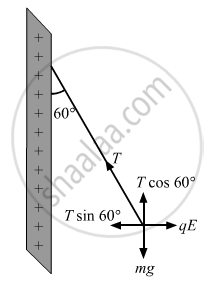
One end of a 10 cm long silk thread is fixed to a large vertical surface of a charged non-conducting plate and the other end is fastened to a small ball of mass 10 g and a charge of 4.0× 10⁻⁶ C. In equilibrium, the thread makes an angle of 60° with the vertical. Find the surface charge density on the plate.

थोडक्यात उत्तर
Advertisements

उत्तर

There are two forces acting on the ball. These are
(1) Weight of the ball, W = mg
(2) Coulomb force acting on the charged ball due to the electric field of the plate, F = qE
 Due to these forces,a tension develops in the thread.
Let the surface charge density on the plate be σ.
Electric field of a plate,

`"E" = sigma /(2∈_0)`

It is given that in equilibrium, the thread makes an angle of 60° with the vertical.
Resolving the tension in the string along horizontal and vertical directions, we get:

T cos 60° = mg

T sin 60°  = qE

`=> tan 60° = "qE"/"mg"`

`=> "E" = ("mg" tan 60 °)/q`

Also, electric field due to a plate,

`"E" = sigma/ 2 ∈_0 =( "mg" tan 60°)/q`

`sigma =(2 ∈_0 "mg" tan 60 °)/"q"`

`sigma =( 2 xx (8.55 xx 10^-12 ) xx ( 10 xx 10 ^-3 xx 9.8) xx 1.7320)/(4.0 xx 10^-6)`

σ = 7.5× 10⁻⁷ C/m2

shaalaa.com
  या प्रश्नात किंवा उत्तरात काही त्रुटी आहे का?
पाठ 8: Gauss’s Law - Exercises [पृष्ठ १४२]

APPEARS IN

एचसी वर्मा Concepts of Physics Vol. 2 [English] Class 11 and 12
पाठ 8 Gauss’s Law
Exercises | Q 19 | पृष्ठ १४२

संबंधित प्रश्‍न

Find the electric force between two protons separated by a distance of 1 fermi (1 fermi = 10−15 m). The protons in a nucleus remain at a separation of this order. 


Estimate the number of electrons in 100 g of water. How much is the total negative charge on these electrons?


Suppose all the electrons of 100 g water are lumped together to form a negatively-charged particle and all the nuclei are lumped together to form a positively-charged particle. If these two particles are placed 10.0 cm away from each other, find the force of attraction between them. Compare it with your weight.


Suppose an attractive nuclear force acts between two protons which may be written as F=Ce−kr/r2. Suppose that k = 1 fermi−1 and that the repulsive electric force between the protons is just balanced by the attractive nuclear force when the separation is 5 fermi. Find the value of C. 


Four equal charges of 2.0 × 10⁻⁶ C each are fixed at the four corners of a square of side 5 cm. Find the Coulomb's force experienced by one of the charges due to the other three. 


Two identically-charged particles are fastened to the two ends of a spring of spring constant 100 N m−1 and natural length 10 cm. The system rests on a smooth horizontal table. If the charge on each particle is 2.0 × 10⁻⁸ C, find the extension in the length of the spring. Assume that the extension is small as compared to the natural length. Justify this assumption after you solve the problem.  


Two particles A and B, each carrying a charge Q, are held fixed with a separation dbetween them. A particle C of mass m and charge q is kept at the middle point of the line AB.   Under what conditions will the particle C execute simple harmonic motion if it is released after such a small displacement? Find the time period of the oscillations if these conditions are satisfied.


Repeat the previous problem if the particle C is displaced through a distance x along the line AB. 


Two identical particles, each with a charge of 2.0 × 10⁻⁴ C and mass of 10 g, are kept at a separation of 10 cm and then released. What would be the speed of the particles when the separation becomes large?


What is relative permittivity?


Explain in detail Coulomb’s law and its various aspects.


A force F acts between sodium and chlorine ions of salt (sodium chloride) when put 1 cm apart in air. The permittivity of air and dielectric constant of water are `epsilon_0` and K respectively. When a piece of salt is put in water, electrical force acting between sodium and chlorine ions 1 cm apart is ____________.


Two positive charges ______.


The value of electric permittivity of free space is ______.

Two charges of equal magnitudes kept at a distance r exert a force F on each other. If the charges are halved and distance between them is doubled, then the new force acting on each charge is ______.


Two charge – 10c and + 10 c are placed 10 cm apart. Potential at centre of the line joining the two charge is:-


The S.I unit of electric permittivity is


Identify the wrong statement in the following.

Coulomb's law correctly describes the electric force that ______.


According to Coulomb's law, which is the correct relation for the following figure?


Which of the following statements about nuclear forces is not true?


Share
Notifications

Englishहिंदीमराठी


      Forgot password?
Use app×