Advertisements
Advertisements
प्रश्न
Advertisements
उत्तर
Two scales in a screw gauge are
(a). A linear scale called the main scale graduated in half millimeters
(b). A circular scale divided into 50 or 100 equal parts.
APPEARS IN
संबंधित प्रश्न
A vernier callipers has a zero error of + 0.06 cm. Draw a neat labelled diagram to represent it.
Name the part of the vernier callipers which is used to measure the following
External diameter of a tube
A screw gauge has 50 divisions on its circular scale and its screw moves by 1 mm on turning it by two revolutions. When the flat end of the screw is in contact with the stud, the zero of the circular scale lies below the base line and 4th division of the circular scale is in line with the base line. Find
(i) The pitch,
(ii) The least count and
(iii) The zero error of the screw gauge
In figure for vernier callipers, calculate the length recorded.
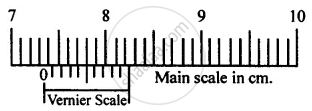
State the correction if the positive error is 7 divisions when the least count is 0.01 cm.
The thimble of a screw gauge has 50 divisions for one rotation. The spindle advances 1 mm when the screw is turned through two rotations.
- What is the pitch of the screw?
- What is the least count of screw gauge?
- When the screw gauge is used to measure the diameter of wire the reading on the sleeve is found to be 0.5 mm and reading on thimble is found, 27 divisions. What is the diameter of the wire in centimetres?
The precision of vernier calipers is ______ mm.
