Advertisements
Advertisements
प्रश्न
Name the components of air with their approximate percentage by volume in air. Does the percentage by volume of each component remain the same, in the atmosphere of different parts of the world? Explain with reasons.
Advertisements
उत्तर
The main components of the air are :
- Nitrogen
- Oxygen
Composition of air by volume:
Nitrogen: 78% or 4/5 th
Oxygen: 21% or 1/5 th
Carbon dioxide: 0.03 - 0.04%
Inert gases: 0.9%
[Water vapours, dust particles, other impurities]: variable
OR
| Gases | Percentage | Figure |
| Nitrogen | 78% | 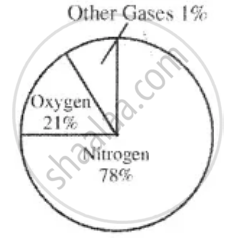 |
| Oxygen | 21% | |
| Carbon dioxide | 0.03 - 0.04% | |
| Inert gases | 0.9% | |
| Water vapour | Varies | |
| Dust particles | Varies | |
| Other impurities | Varies |
Air is a mixture whose composition varies at different intervals of time and different places of the world.
संबंधित प्रश्न
Explain the conversion of nitrogen into nitrates during lightning.
Complete and balance the following chemical equation.
\[\ce{HgO ->[heat]}\] ______ + _______
Name three noble gases present in the air. State their one industrial use
Statement given below is incorrect. Write the correct statement :
Potassium nitrate on strong heating decomposes into potassium nitrite and nitrogen gas.
The diagrams below represents an experiment to show the presence of a component of air.
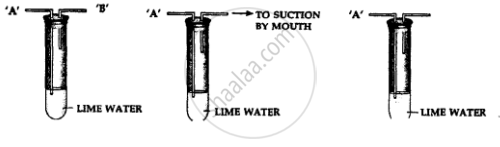
- State why air is sucked from – outlet ‘B’ and not from outlet “A”
- State why the air is sucked ‘slowly’ from the outlet “B”
- State the observation seen after completion of the experiment.
- State the reason for the above observation seen.
- Name another component which if present in air as a pollutant would have given a similar observation
Write about the reaction of nitrogen with non metals.
Soda bottle bursts sometimes when it is opened during summer. Why?
“Air is not an elementary substance, but a composition”. Why?
The solid form of CO2 is called dry ice which undergoes condensation.
Write just a few sentences for an imaginary situation if any of the following gases disappear from the atmosphere.
Nitrogen
