Advertisements
Advertisements
प्रश्न
Mention the various energy losses in a transformer.
Advertisements
उत्तर
Energy losses in a transformer: Transformers do not have any moving parts so that its efficiency is much higher than that of rotating machines like generators and motors. But there are many factors which lead to energy loss in a transformer.
- Core loss or Iron loss:
This loss takes place in the transformer core. Hysteresis loss and eddy current loss are known as core loss or Iron loss. When the transformer core is magnetized and demagnetized repeatedly by the alternating voltage applied across primary coil, hysteresis takes place due to which some energy is lost in the form of heat.
Hysteresis loss is minimized by using steel of high silicon content in making transformer core. Alternating magnetic flux in the core induces eddy currents in it. Therefore there is energy loss due to the flow of eddy current, called eddy current loss which is minimized by using very thin laminations of the transformer core. - Copper loss:
Transformer windings have electrical resistance. When an electric current flows through them, some amount of energy is dissipated due to Joule heating. This energy loss is called copper loss which is minimized by using wires of larger diameter. - Flux leakage:
Flux leakage happens when the magnetic lines of primary coil arc not completely linked with secondary coil. Energy loss due to this flux leakage is minimized by winding coils one over the other.
APPEARS IN
संबंधित प्रश्न
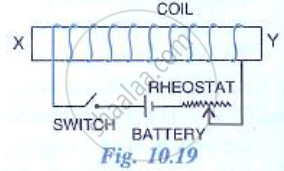
The adjacent diagram shows a coil would around a soft iron bar XY. (a) State the polarity at the end X and Y as the switch is pressed. (b) Suggest one way increasing the strength of electromagnet so formed.
State the principle of working of a transformer. Can a transformer be used to step up or step down a d.c. voltage? Justify your answer.
What is Transformer?
A step-down transformer reduces the supply voltage from 220 V to 11 V and increase the current from 6 A to 100 A. Then its efficiency is
Explain the construction of transformer.
An ideal transformer converts 220 V a.c. to 3.3 kV a.c. to transmit a power of 4.4 kW. If primary coil has 600 turns, then alternating current in secondary coil is ______.
What does the laminated soft iron core provide for the flux?
Why is soft iron used in the core?
Which winding is the input coil connected to the AC source?
