Advertisements
Advertisements
प्रश्न
Match the terms of column I with those in column II:
| Column I | Column II |
| (i) Stomata closed | (a) decomposers |
| (ii) Autotrophs | (b) light reaction |
| (iii) By-products of photosynthesis | (c) animals |
| (iv) Photolysis | (d) during night |
| (v) Bacteria and fungi | (e) green plants |
| ( f) oxygen |
Advertisements
उत्तर
(i) (d) During night
(ii) (e) Green plants
(iii) (f) Oxygen
(iv) (b) Light reaction
(v) (a) Decomposers
APPEARS IN
संबंधित प्रश्न
Cochlea, Malleus, Pinna, Stapes, Incus.
Given below is an experiment setup to demonstrate a particualr tropic movement in germinating seeds. Study the diagram and answer the questions that follow :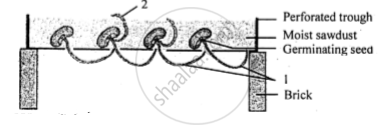
(ii) Name the tropic movement shown by part 1.
The diagram given below represents an experiment to prove the importance of a factor in photosynthesis. Answer the questions that follow:
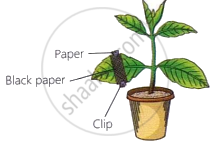
- Name the factor studied in this experiment.
- What will you observe in the experimental leaf after the starch test?
- Explain the process of photosynthesis.
- Give a balanced chemical equation to represent the process of photosynthesis.
- Draw a neat, labelled diagram of an experimental setup to show that oxygen is released during photosynthesis.
Choose the correct answer:
The process of photosynthesis occurs by _________
Name the following:
The category of organisms that prepare their own food from basic raw materials.
A candidate studied the importance of certain factors in photosynthesis. He took a potted plant and kept in the dark for over 24 hours. In the early hours of the next morning, he covered one of the leaves with black paper in the centre only. Then he placed the plant in sunlight for a few hours and tested the leaf which was covered with black paper for starch.
Why was the plant kept in the dark before the experiment?
Photosynthesis is considered as a process supporting all life on earth.
Give technical term:
The part of the chloroplast where the dark reaction of photosynthesis takes place.
Mention, if the following statement is True or False. If false rewrite the wrong statement in its correct form:
The raw materials for photosynthesis include water and CO2.
Which gas evolved during photosynthesis?
