Advertisements
Advertisements
प्रश्न
Match the following:
| Column A | Column B |
| 1. A substance that turns moist starch iodide paper blue. | A. Ammonium sulphate |
| 2. A compound which release a reddish brown gas on reaction with concentrated sulphuric acid and copper turnings. | B. Lead carbonate |
| 3. A solution of this compound gives dirty green precipitate with sodium hydroxide. | C. Chlorine |
| 4. A compound which on heating with sodium hydroxide produces a gas which forms dense white fumes with hydrogen chloride. | D. Copper nitrate |
| 5. A white solid which gives a yellow residue on heating | E. Ferrous sulphate |
Advertisements
उत्तर
| Column A | Column B |
| 1. A substance that turns moist starch iodide paper blue. | C. Chlorine |
| 2. A compound which release a reddish brown gas on reaction with concentrated sulphuric acid and copper turnings. | D. Copper nitrate |
| 3. A solution of this compound gives dirty green precipitate with sodium hydroxide. | E. Ferrous sulphate |
| 4. A compound which on heating with sodium hydroxide produces a gas which forms dense white fumes with hydrogen chloride. | A. Ammonium sulphate |
| 5. A white solid which gives a yellow residue on heating | B. Lead carbonate |
APPEARS IN
संबंधित प्रश्न
State one relevant observation for given reactions:
Action of dilute Hydrochloric acid on iron (II) sulfide.
Give a chemical test to distinguish between the given pairs of chemicals:
Sodium chloride solution and Sodium nitrate solution
How will the action of dilute hydrochloric acid enable you to distinguish between sodium carbonate and sodium sulphite?
Name the following:
Five oxidizing agents that liberated chlorine from concentrated hydrochloric acid.
Write balanced equation for the following reaction:
Copper oxide and dilute hydrochloric acid.
Write an equation for the reactions of hydrochloric acid on manganese (IV) oxide.
State which of the two - a solution of HCl in water or in toluene is an electrolyte. Explain.
Write an equation for the reaction of hydrochloric acid on manganese (IV) oxide.
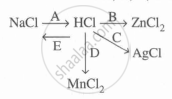
Study the flow chart and give balanced equations with conditions for the conversions A, B, C, D, and E.
The ratio between the volumes occupied by 4.4 grams of carbon dioxide and 2 grams of hydrogen gas is ______.
