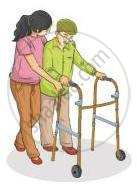
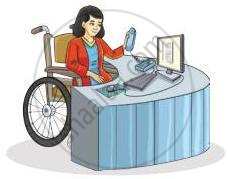
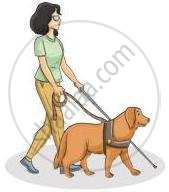
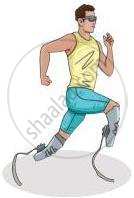
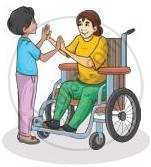
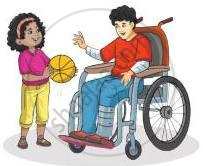
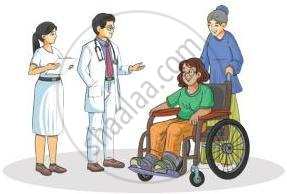
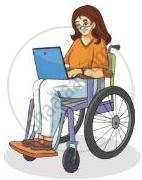
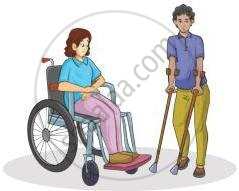
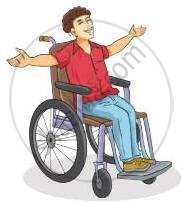
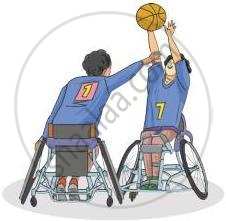
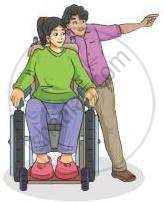
Look carefully at the Fig. showing people with different disabilities (wheelchair users, a person with a guide dog, an amputee athlete, etc.). Discuss with your teachern. Discuss in pairs or small
Advertisements
प्रश्न
Look carefully at the Fig. showing people with different disabilities (wheelchair users, a person with a guide dog, an amputee athlete, etc.).
Discuss with your teacher and find out the list of 21 disabilities under the RPwD Act, 2016, and identify which types of disabilities you think are represented in the picture.
Example: Person using a wheelchair, Locomotor Disability. Person walking with a guide dog for Blindness or Low Vision.
 |
 |
 |
 |
 |
 |
 |
 |
 |
 |
 |
 |
Discuss in pairs or small groups
1. Which disabilities are visible in the image?
…………………………………...........................
2. Which disabilities are not visible but are still important (like learning disabilities, autism and blood disorders)?
…………………………………............................
Write down your answers below:
| Visible Disabilities (shown in the picture) | Invisible Disabilities (given in the list, but not shown in the picture) |
Advertisements
उत्तर
Under the Rights of Persons with Disabilities (RPwD) Act, 2016, 21 disabilities are recognised: blindness, low vision, leprosy-cured persons, hearing impairment, locomotor disability, dwarfism, intellectual disability, mental illness, autism spectrum disorder, cerebral palsy, muscular dystrophy, chronic neurological conditions, specific learning disabilities, multiple sclerosis, speech and language disability, thalassaemia, haemophilia, sickle cell disease, multiple disabilities including deaf-blindness, acid attack victims and Parkinson's disease.
| Visible Disabilities (shown in the picture) | Invisible Disabilities (given in the list, but not shown in the picture) |
| Locomotor Disability – people using wheelchairs, a walker, forearm crutches, and an amputee athlete with prosthetic blades | Hearing impairment (deaf/hard of hearing); speech and language disability |
| Blindness/Low Vision – the person walking with a guide dog | Intellectual disability; specific learning disabilities; autism spectrum disorder; mental illness |
| Other visible forms of locomotor disability shown in wheelchair sports and daily activities | Blood disorders – thalassaemia, haemophilia, sickle cell disease; chronic neurological conditions, multiple sclerosis, muscular dystrophy, cerebral palsy, dwarfism, Parkinson's disease, acid attack victims, leprosy-cured persons, multiple disabilities including deaf-blindness |
