Advertisements
Advertisements
प्रश्न
In the given figure, ∠B = 60°, ∠C = 30°, AB = 8 cm and BC = 24 cm. Find:
a. BE
b. AC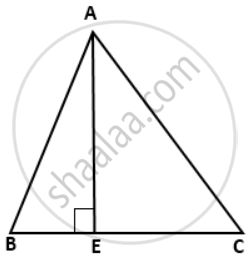
योग
Advertisements
उत्तर

a. In right ΔAEB,
sin60° = `"AE"/"AB"`
⇒ `sqrt(3)/(2) = "AE"/(8)`
⇒ AE = `4sqrt(3)"cm"`
Now,
BE2
= AB2 - AE2
= `8^2 - (4sqrt(3))^2`
= 64 - 48
= 16
⇒ BE = 4cm
b. EC
= BC - BE
= 24 - 4
= 20cm
Now,
In right ΔAEC,
AC2
= AE2 + EC2
= `(4sqrt(3))^2 + 20^2`
= 48 + 400
= 448
⇒ AC = `8sqrt(7)"cm"`.
shaalaa.com
Trigonometric Equation Problem and Solution
क्या इस प्रश्न या उत्तर में कोई त्रुटि है?
