Advertisements
Advertisements
प्रश्न
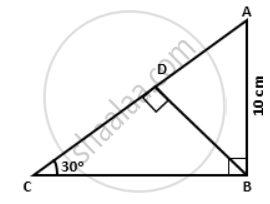
Find:
a. BC
b. AD
c. AC
Advertisements
उत्तर
a. In right ΔABC,
tan30° = `"AB"/"BC"`
⇒ `(1)/sqrt(3) = (10)/"BC"`
⇒ BC = `10sqrt(3)"cm"`.
b. In ΔABC, ∠C = 30° and ∠B = 90°
⇒ ∠A = 60°
Now, In ΔABD,
cos60° = `"AD"/"AB"`
⇒ `(1)/(2) = "AD"/(10)`
⇒ AD = 5cm
c. In ΔABC,
AC2
= AB2 + BC2
= `10^2 + (10sqrt(30))^2`
= 100 + 300
= 400cm
⇒ AC = 20cm.
APPEARS IN
संबंधित प्रश्न
If 2 sin x° − 1 = 0 and x° is an acute angle; find:
- sin x°
- x°
- cos x° and tan x°.
Solve the following equation for A, if tan 3 A = 1
Find the value of 'A', if 2 sin 2A = 1
Find the value of 'A', if (2 - cosec 2A) cos 3A = 0
In a trapezium ABCD, as shown, AB ‖ DC, AD = DC = BC = 24 cm and ∠A = 30°. Find: length of AB
In the given figure, AB and EC are parallel to each other. Sides AD and BC are 1.5 cm each and are perpendicular to AB. Given that ∠AED = 45° and ∠ACD = 30°. Find:
a. AB
b. AC
c. AE
Find the value 'x', if:
Find x and y, in each of the following figure:
Express each of the following in terms of trigonometric ratios of angles between 0° and 45°: tan77° - cot63° + sin57°
Evaluate the following: `(5cot5° cot15° cot25° cot35° cot45°)/(7tan45° tan55° tan65° tan75° tan85°) + (2"cosec"12° "cosec"24° cos78° cos66°)/(7sin14° sin23° sec76° sec67°)`
