Advertisements
Advertisements
प्रश्न
In the given figure, a rocket is fired vertically upwards from its launching pad P. It first rises 20 km vertically upwards and then 20 km at 60° to the vertical. PQ represents the first stage of the journey and QR the second. S is a point vertically below R on the horizontal level as P, find:
a. the height of the rocket when it is at point R.
b. the horizontal distance of point S from P.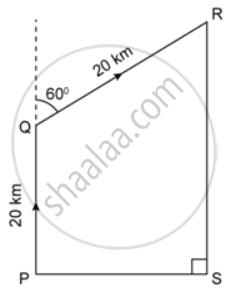
योग
Advertisements
उत्तर
Draw QM ⊥ RS.
Clearly, ∠RQM = 30° 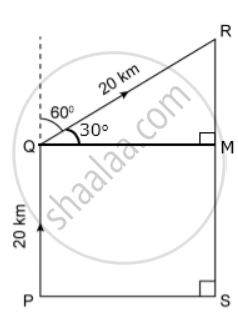
a. In right ΔRMQ,
sin30° = `"RM"/"RQ"`
⇒ `(1)/(2) = "RM"/(20)`
⇒ RM = 10km
∴ The height of the rocket when it is at point R
= RS
= RM + MS
= 10km + 20km
= 30km.
b. In right ΔRMQ,
cos30° = `"QM"/"RQ"`
⇒ `sqrt(3)/(2) = "QM"/(20)`
⇒ QM = `10sqrt(3)"km"`
∴ The horizontal distance of point S from P
=PS
= QM
= `10sqrt(3)"km"`.
shaalaa.com
Trigonometric Equation Problem and Solution
क्या इस प्रश्न या उत्तर में कोई त्रुटि है?
