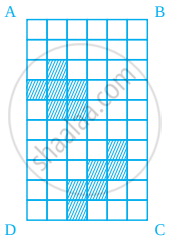
In the following figure, each square is of unit length What is the perimeter of the rectangle ABCD? What is the area of the rectangle ABCD?
Advertisements
प्रश्न
In the following figure, each square is of unit length
- What is the perimeter of the rectangle ABCD?
- What is the area of the rectangle ABCD?
- Divide this rectangle into ten parts of equal area by shading squares. (Two parts of equal area are shown here)
- Find the perimeter of each part which you have divided. Are they all equal?
Advertisements
उत्तर
Given, each side of square is of unit length.
Figure contains length of 10 squares and width of 6 squares.
Now, length of rectangle, AD = BC
= Sum of length of a side of 10 squares
= 1 + 1 + 1 + 1 + 1 + 1 + 1 + 1 + 1 + 1
= 10 × 1
= 10 units and breadth of rectangle, AB = DC
= Width of 6 squares
= 6 × 1
= 6 units
a. The perimeter of the rectangle ABCD
= AB + BC + CD + DA
= 6 + 10 + 6 + 10
= 32 units
b. The area of the rectangle ABCD
= Length × Breadth
= AD × AB
= `600/10`
= 60 sq.units
c. The total area of rectangle = 60 sq.units.
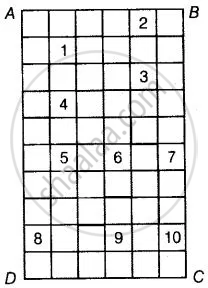
Now, we have to divide the rectangle into 10 equal parts i.e., 6 × 1 = 6 square units, i.e., we have to take a group of 6 – 6 square blocks, which is shown in the figure.
d. Now, we find the perimeter of part I.
We know that perimeter of a figure is the total length of its boundary.
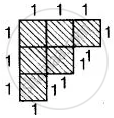
Perimeter of part 1 = 1 + 1 + 1 + 1 + 1 + 1 + 1 + 1 + 1 + 1 + 1 + 1 = 12 units.
Similarly, we can find the perimeters of remaining 9 parts, all the parts have same perimeter, i.e., 12 units.
Yes, all the parts have same perimeter.
APPEARS IN
संबंधित प्रश्न
A path of uniform width, 3 m, runs around the outside of a square field of side 21 m. Find the area of the path.
The length of a hall is 18 m and its width is 13.5 m. Find the least number of square tiles, each of side 25 cm, required to cover the floor of the hall,
(i) without leaving any margin.
(ii) leaving a margin of width 1.5 m all around. In each case, find the cost of the tiles required at the rate of Rs. 6 per tile
Draw a square B whose side is twice of the square A. Calculate the perimeter of the squares A and B
1 sq cm = ______ cm × 1 cm.
1 sq m = 1 m × ______ m = 100 cm × ______ cm.
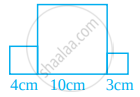
Three squares are joined together as shown in the following figure. Their sides are 4 cm, 10 cm and 3 cm. Find the perimeter of the figure.
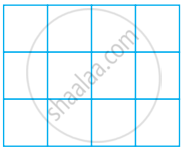
In the following figure, perimeter of (ii) is the same as (i).
 |
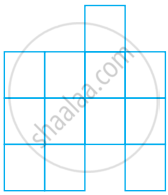 |
| (i) | (ii) |
Three squares are attached to each other as shown in the following figure. Each square is attached at the mid-point of the side of the square to its right. Find the perimeter of the complete figure.

If the perimeter of a square is 36 cm, what is the length of one side?
Which statement is always true for a square?
