Advertisements
Advertisements
प्रश्न
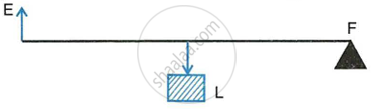
In the diagram shown alongside a claw hammer, mark the fulcrum (F) and indicate the directions of load (L) and effort (E) with arrows. What class of lever is it? Give one more example of this class of lever.

Advertisements
उत्तर
Claw-hammer is the lever of the first order. One more example of this class of lever is a see-saw. In the following diagram, F indicates the position of the fulcrum. The arrows labelled L and E respectively indicate the directions of load and effort.
संबंधित प्रश्न
The diagram below shows a lever in use:
- To which class of levers does it belong?
- Without changing the dimensions of the lever, if the load is shifted towards the fulcrum what happens to the mechanical advantage of the lever?
Write down a relation expressing the mechanical advantage of a lever.
shows a nut cracker name the class of lever ?
Give three examples for leavers of the third order.
The following belong to which class of lever?
A claw-hammer
The following belong to which class of lever?
A fire tongs
The following belong to which class of lever?
Fore-arm
Shears, used for cutting metals and scissors used for cutting clothes are both examples of levers of the first order. However, whereas the shears always have short blades and long handles, the scissors often have blades much longer than the handles. Explain, why this is so?
Draw a labelled sketch of a second class lever. Give one example of such a lever.
The diagram below shows a lever in use.

(i) To which class of lever does it belong?
(ii) If FA = 40 cm, AB = 60 cm, then find the mechanical advantage of the lever.
