Advertisements
Advertisements
प्रश्न
In quadrilateral ACBD, AC = AD and AB bisects ∠A (See the given figure). Show that ΔABC ≅ ΔABD. What can you say about BC and BD?

Advertisements
उत्तर
Given: In quadrilateral ABCD, AC = AD and AB bisects ∠A.
To prove: △ABC ≌ △ABD
Proof: In △ABC and △ABD,
AC = AD ...[Given]
∠BAC = ∠BAD ...[∵ AB bisects ∠A]
AB = AB ...[Common]
∴ △ABC ≌ △ABD ...[By SAS congruence rule]
Hence, BC = BD ...[Corresponding parts of congruent triangles]
APPEARS IN
संबंधित प्रश्न
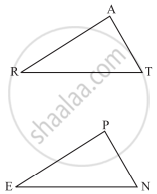
You want to show that ΔART ≅ ΔPEN,
If you have to use SSS criterion, then you need to show
1) AR =
2) RT =
3) AT =
In Δ ABC, ∠B = 35°, ∠C = 65° and the bisector of ∠BAC meets BC in P. Arrange AP, BP and CP in descending order.
Prove that the perimeter of a triangle is greater than the sum of its altitudes.
In two triangles ABC and DEF, it is given that ∠A = ∠D, ∠B = ∠E and ∠C =∠F. Are the two triangles necessarily congruent?
If the following pair of the triangle is congruent? state the condition of congruency:
In ΔABC and ΔPQR, AB = PQ, AC = PR, and BC = QR.
The given figure shows a circle with center O. P is mid-point of chord AB.
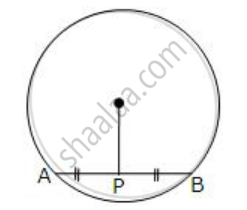
Show that OP is perpendicular to AB.
In a triangle ABC, D is mid-point of BC; AD is produced up to E so that DE = AD. Prove that:
AB is parallel to EC.
In the following diagram, ABCD is a square and APB is an equilateral triangle.
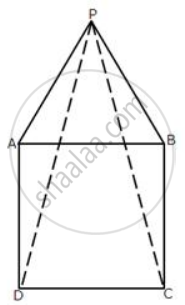
- Prove that: ΔAPD ≅ ΔBPC
- Find the angles of ΔDPC.
A point O is taken inside a rhombus ABCD such that its distance from the vertices B and D are equal. Show that AOC is a straight line.
In ΔABC, AB = AC and the bisectors of angles B and C intersect at point O.
Prove that : (i) BO = CO
(ii) AO bisects angle BAC.
