Advertisements
Advertisements
प्रश्न
ABCD is a quadrilateral in which AD = BC and ∠DAB = ∠CBA (See the given figure). Prove that
- ΔABD ≅ ΔBAC
- BD = AC
- ∠ABD = ∠BAC.

Advertisements
उत्तर
In quadrilateral ABCD, we have
AD = BC and ∠DAB = ∠CBA
i. In ΔABD and ΔBAC,
AD = BC ...[Given]
∠DAB = ∠CBA ...[Given]
AB = BA ...[Common]
∴ ΔABD ≅ ΔBAC ...[By SAS congruency]
ii. Since ΔABD ≅ ΔBAC
BD = AC ...[By Corresponding parts of congruent triangles]
iii. Since ΔABD ≅ ΔBAC
∠ABD = ∠BAC ...[By Corresponding parts of congruent triangles]
APPEARS IN
संबंधित प्रश्न
Which congruence criterion do you use in the following?
Given: ∠MLN = ∠FGH
∠NML = ∠GFH
ML = FG
So, ΔLMN ≅ ΔGFH
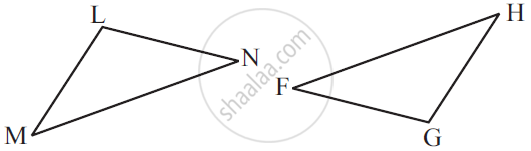
In ΔABC, ∠A = 30°, ∠B = 40° and ∠C = 110°
In ΔPQR, ∠P = 30°, ∠Q = 40° and ∠R = 110°
A student says that ΔABC ≅ ΔPQR by AAA congruence criterion. Is he justified? Why or why not?
ABCD is a square, X and Yare points on sides AD and BC respectively such that AY = BX. Prove that BY = AX and ∠BAY = ∠ABX.
Prove that the perimeter of a triangle is greater than the sum of its altitudes.
If ABC and DEF are two triangles such that AC = 2.5 cm, BC = 5 cm, ∠C = 75°, DE = 2.5 cm, DF = 5cm and ∠D = 75°. Are two triangles congruent?
In triangles ABC and CDE, if AC = CE, BC = CD, ∠A = 60°, ∠C = 30° and ∠D = 90°. Are two triangles congruent?
The given figure shows a circle with center O. P is mid-point of chord AB.
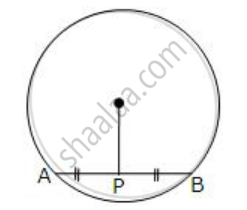
Show that OP is perpendicular to AB.
In a triangle ABC, D is mid-point of BC; AD is produced up to E so that DE = AD. Prove that:
AB is parallel to EC.
A triangle ABC has ∠B = ∠C.
Prove that: The perpendiculars from the mid-point of BC to AB and AC are equal.
In the following figure, OA = OC and AB = BC.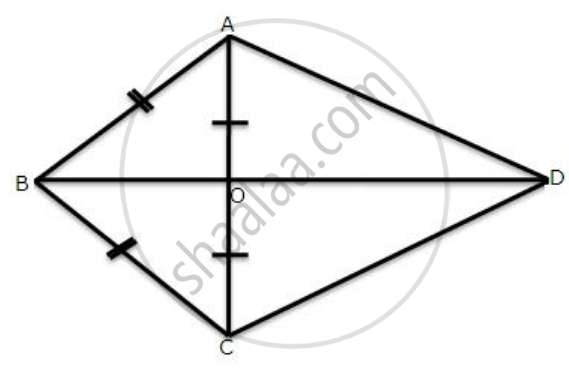
Prove that: ΔAOD≅ ΔCOD
