Advertisements
Advertisements
प्रश्न
ABCD is a quadrilateral in which AD = BC and ∠DAB = ∠CBA (See the given figure). Prove that
- ΔABD ≅ ΔBAC
- BD = AC
- ∠ABD = ∠BAC.

Advertisements
उत्तर
In quadrilateral ABCD, we have
AD = BC and ∠DAB = ∠CBA
i. In ΔABD and ΔBAC,
AD = BC ...[Given]
∠DAB = ∠CBA ...[Given]
AB = BA ...[Common]
∴ ΔABD ≅ ΔBAC ...[By SAS congruency]
ii. Since ΔABD ≅ ΔBAC
BD = AC ...[By Corresponding parts of congruent triangles]
iii. Since ΔABD ≅ ΔBAC
∠ABD = ∠BAC ...[By Corresponding parts of congruent triangles]
APPEARS IN
संबंधित प्रश्न
l and m are two parallel lines intersected by another pair of parallel lines p and q (see the given figure). Show that ΔABC ≅ ΔCDA.

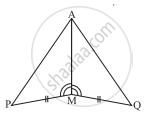
You have to show that ΔAMP ≅ AMQ.
In the following proof, supply the missing reasons.
| Steps | Reasons | ||
| 1 | PM = QM | 1 | ... |
| 2 | ∠PMA = ∠QMA | 2 | ... |
| 3 | AM = AM | 3 | ... |
| 4 | ΔAMP ≅ ΔAMQ | 4 | ... |
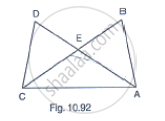
In Fig. 10.92, it is given that AB = CD and AD = BC. Prove that ΔADC ≅ ΔCBA.
If ABC and DEF are two triangles such that AC = 2.5 cm, BC = 5 cm, ∠C = 75°, DE = 2.5 cm, DF = 5cm and ∠D = 75°. Are two triangles congruent?
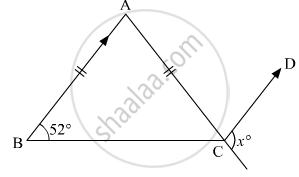
In the given figure, ABC is an isosceles triangle whose side AC is produced to E. Through C, CD is drawn parallel to BA. The value of x is
A triangle ABC has ∠B = ∠C.
Prove that: The perpendiculars from B and C to the opposite sides are equal.
In the following figure, BL = CM.
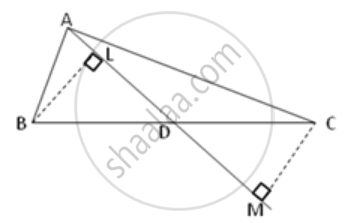
Prove that AD is a median of triangle ABC.
In the figure, given below, triangle ABC is right-angled at B. ABPQ and ACRS are squares. 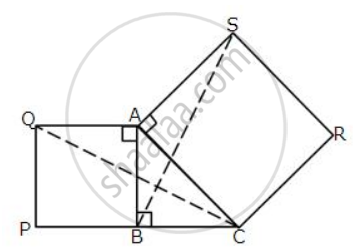
Prove that:
(i) ΔACQ and ΔASB are congruent.
(ii) CQ = BS.
A point O is taken inside a rhombus ABCD such that its distance from the vertices B and D are equal. Show that AOC is a straight line.
In the following figure, OA = OC and AB = BC.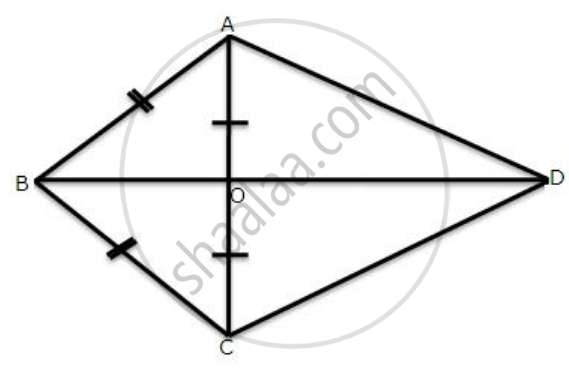
Prove that: ΔAOD≅ ΔCOD
