Advertisements
Advertisements
प्रश्न
In a parallelogram ABCD, if ∠A = (3x − 20)°, ∠B = (y + 15)°, ∠C = (x + 40)°, then find the values of xand y.
Advertisements
उत्तर
In parallelogram ABCD, ∠A and ∠C are opposite angles.
We know that in a parallelogram, the opposite angles are equal.
Therefore,
∠C = ∠A
We have ∠A = (3x - 20°) and ∠C = (x + 40°)
Therefore,
x + 40° = 3x - 20°
x - 3x = -40° - 20°
-2x = - 60°
x = 30°
Therefore,
∠A = (3x - 20°)
∠A = [3(30) - 20°]
∠A = 70°
Similarly,
∠C = 70°
Also, ∠B = ( y + 15)°
Therefore,
∠D = ∠B
∠D = (y + 15 )°
By angle sum property of a quadrilateral, we have:
∠A + ∠B + ∠C + ∠D = 360°
70° +(y + 15)° + 70° + (y + 15)° = 360°
140° + 2 (y + 15)° = 360°
2(Y + 15)° = 360° - 140°
2(y + 15)° = 220°
(y + 15)° = 110°
y = 95°
Hence the required values for x and y are 30° and 95° respectively.
APPEARS IN
संबंधित प्रश्न
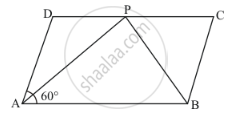
In Fig., below, ABCD is a parallelogram in which ∠A = 60°. If the bisectors of ∠A and ∠B meet at P, prove that AD = DP, PC = BC and DC = 2AD.
In a parallelogram ABCD, determine the sum of angles ∠C and ∠D .
In a parallelogram ABCD, if `∠`B = 135°, determine the measures of its other angles .
P and Q are the points of trisection of the diagonal BD of a parallelogram AB Prove that CQ is parallel to AP. Prove also that AC bisects PQ.
In a ΔABC median AD is produced to X such that AD = DX. Prove that ABXC is a
parallelogram.
In a parallelogram ABCD, write the sum of angles A and B.
The figure formed by joining the mid-points of the adjacent sides of a parallelogram is a
ABCD is a parallelogram in which diagonal AC bisects ∠BAD. If ∠BAC = 35°, then ∠ABC =
In the given figure, ∠A = 64°, ∠ABC = 58°. If BO and CO are the bisectors of ∠ABC and ∠ACB respectively of ΔABC, find x° and y°
In the given Figure, if AB = 2, BC = 6, AE = 6, BF = 8, CE = 7, and CF = 7, compute the ratio of the area of quadrilateral ABDE to the area of ΔCDF. (Use congruent property of triangles)
