Advertisements
Advertisements
प्रश्न
If measures opposite angles of a parallelogram are (60 − x)° and (3x − 4)°, then find the measures of angles of the parallelogram.
Advertisements
उत्तर
Let ABCD be a parallelogram, with ∠A = (60 - x )° and∠C = (3x - 4).
We know that in a parallelogram, the opposite angles are equal.
Therefore,
∠A = ∠C
60 - x = 3x - 4
-x 3x = - 4 - 60
-4x = -64
x = 16
Thus, the given angles become
∠A = (60 - x)°
= (60 - 16)°
= 44 °
Similarly,
∠C = 44°
Also, adjacent angles in a parallelogram form the consecutive interior angles of parallel lines, which must be supplementary.
Therefore,
∠A +∠B = 180°
44° + ∠B = 180°
∠B = 180° - 44°
∠B = 136°
Similarly,
∠D = ∠B
∠D = 136°
Thus, the angles of a parallelogram are 44°,136°,44° and136° .
APPEARS IN
संबंधित प्रश्न
The angles of quadrilateral are in the ratio 3: 5: 9: 13. Find all the angles of the quadrilateral.
Show that if the diagonals of a quadrilateral bisect each other at right angles, then it is a rhombus.
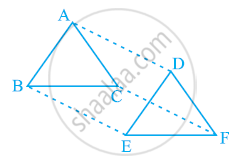
In ΔABC and ΔDEF, AB = DE, AB || DE, BC = EF and BC || EF. Vertices A, B and C are joined to vertices D, E and F respectively (see the given figure). Show that
(i) Quadrilateral ABED is a parallelogram
(ii) Quadrilateral BEFC is a parallelogram
(iii) AD || CF and AD = CF
(iv) Quadrilateral ACFD is a parallelogram
(v) AC = DF
(vi) ΔABC ≅ ΔDEF.
In a parallelogram ABCD, ∠D = 135°, determine the measures of ∠A and ∠B
The following statement are true and false.
In a parallelogram, the diagonals bisect each other.
The following statement are true and false .
If all the sides of a quadrilateral are equal it is a parallelogram.
If ABCD is a rhombus with ∠ABC = 56°, find the measure of ∠ACD.
The perimeter of a parallelogram is 22 cm. If the longer side measures 6.5 cm, what is the measure of shorter side?
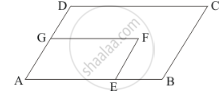
In the given figure, ABCD and AEFG are two parallelograms. If ∠C = 58°, find ∠F.
In a parallelogram ABCD, if ∠DAB = 75° and ∠DBC = 60°, then ∠BDC =
